


#1071
Give Them to Others
Every time you give charity, you should feel great joy.
Look for opportunities that you might otherwise have overlooked. For
example, give away old things that you don't need anymore to someone who
can't afford them.
(For a series of probing questions on this topic, see Rabbi Pliskin's "Gateway to Self Knowledge," pp.147-8)
#1072
Suffering Teaches Modesty
Rabbi Samson Raphael Hirsch wrote: "Suffering is a great
teacher. Suffering teaches you the limitations of your power. It reminds
you of the frailty of your health, the instability of your possessions,
and the inadequacy of your
means which have only been lent to you and must be returned as soon as
the Owner desires it. Suffering visits you and teaches you the
nothingness of your false greatness. It teaches you modesty."
("Horeb," vol.1, p.36; Rabbi Pliskin's Gateway to Happiness, p.247)

26 Kislev
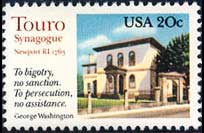
In
1763, the Touro Synagogue was dedicated in Newport, Rhode Island. It is
the oldest existing synagogue in the United States, founded by Spanish
Portuguese families who came from Curacao, in the West Indies. The
magnificent synagogue is built of brick imported from England, and
stands at an acute angle to the street -- so that the Holy Ark faces
toward Jerusalem. The synagogue is named after Abraham Touro, who left
money in his will for the ongoing care of the synagogue. George
Washington had issued a famous letter to the congregation promising
religious freedom, and in 1982 the United States Postal Service issued a
stamp featuring Touro Synagogue, to coincide with the 250th anniversary
of Washington's birth.
27 Kislev
In
1966, Shmuel Yosef (Shay) Agnon (1888-1970) was awarded the Nobel Prize
in Literature. Agnon's writings deal with the conflict between
traditional Jewish life and language, and the modern world. Agnon, a
religious Jew, also attempted to capture the fading traditions of the
European shtetl (village). Agnon was born in Ukraine, the son of an
ordained rabbi. At age 20 he moved to Israel. In his speech at the Nobel
Prize ceremony, Agnon spoke in Hebrew: "As a result of the historic
catastrophe in which Titus of Rome destroyed Jerusalem and Israel was
exiled from its land, I was born in one of the cities of the exile. But
always I regarded myself as one who was born in Jerusalem." Today,
Agnon's image is featured on the Israeli 50-shekel bills.

26 Kislev
Although
the acceptable amount [of water for ritual washing of the hands before
meals] is a fourth of a log, one should use abundant water in washing (Orach Chaim 158:10).
The Talmud states that Rabbi Chisda attributed his good fortune to his practice of using abundant water in the ritual washing.
Rabbi Yisroel of Salant was at an inn, and when he washed his hands for
the meal, he was careful to use the minimum amount of water required.
When his students wondered why he did not follow the recommendations of
the Shulchan Aruch (Code of Law), Rabbi Yisroel replied, "Perhaps you
did not notice that a servant fetched the water from a well. If I used
water lavishly, it would be at her expense."
Many times the Shulchan Aruch states the letter of the law, then add
that it is commendable to go beyond it in stricter observance. However,
such extra observance is only done for oneself. For instance, when
rabbis are asked about the permissibility of any given practice, they
must render their decision according to the letter of the law, but may
add that stricter observance is commendable but not mandatory. Rabbis
are not permitted to require from others more than the law dictates,
even if their personal standards of observance are more demanding.
Today I shall ...
... try to increase my expectations of myself, but not at the expense of others.
27 Kislev
All my days I grew up among the wise, and I have not found what is good for the body other than silence (Ethics of the Fathers1:17).
In his famous instructions on the "golden mean of virtue,"
Maimonides states that a person should avoid either extreme of any
character trait.
If we were to place unbridled talk at one extreme and total silence at
the other, the mean of virtue would not be at the midpoint between the
two, but much closer to silence. While sometimes we refrain from saying
something we should have said, more often do we say something we should
not have said.
We can choose one of two paths of conversation: We either keep quiet
unless we are certain that we should speak, or we assume that we should
speak unless we are certain that we should hold our peace. Since the
mean of virtue is closer to silence, the first option is preferable.
People who were forbidden to talk for medical reasons and therefore had
to communicate by writing have told me that they realized how much of an
average person's conversation is non-essential. Unfortunately,
non-essential talk is likely to contain much that is not simply
"neutral," but actually destructive, such as lies, gossip, insults,and
boasting.
Today I shall ...
... try to measure my words very carefully. If there is no real need
for saying something, I should reflect on why I wish to say it.

