


#1127
Use Suffering As A Reminder
When some people suffer, they complain about their situation.
At the opposite extreme are people who have developed a philosophical
attitude toward suffering and do not even feel it. The proper Torah
attitude is to utilize suffering as a reminder to improve oneself.
(Rabbi Simcha Zissel of Kelm - Chochmah Umussar, vol.2, p.62; Rabbi Pliskin's Gateway to Happiness, p.244)
#1128
Focus on the Task at Hand
Our attitude toward obligations should be that only one more
day exists, that there is only one thing to accomplish, and you are the
only one who can do it.
(Michtevai Chafetz Chaim, p.110; Rabbi Pliskin's Gateway to Happiness, p.150)

23 Shevat
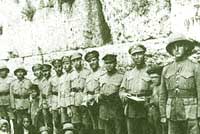
On
this date in 1918, the Jewish Legion left England to join the Allies in
liberating Palestine from the Turks. Four years earlier, Zev Jabotinsky
had proposed that a Jewish legion be formed, but the British resisted
the idea of Jewish volunteers fighting on the Palestinian front; this
led instead to the establishment of the Zion Mule Corps. Meanwhile,
Jabotinsky pursued his project of a Jewish Legion, which was eventually
designated as the 38th Battalion of the Royal Fusiliers. It included
British volunteers, members of the former Zion Mule Corps, a large
number of Russian Jews, and later joined by a large number of American
volunteers. A few years later, the Jewish Legion was demobilized by the
anti-Zionist British Military Administration. Yet it would be remembered
as the first organized Jewish fighting force since Roman times, and a
precursor to the Israeli Defense Force (IDF).
24 Shevat

In
354 BCE, the prophet Zechariah predicted the rebuilding of Zion, as
recorded in the biblical Book of Zechariah (1:7). King Darius of Persia
had given permission to rebuild the second Holy Temple, and Zechariah
rebuked the people for not quickly taking the opportunity to do so.

23 Shevat
"Master of the world, Who reigned before anything was created" (Siddur).
The prayer Adon Olam is the opening prayer of the
morning service; some congregations also recite it at the close of the
evening service. It is also included in the extended version of the
prayer upon retiring.
Adon Olam's being both the opening and closing prayer is similar to the practice of beginning the reading of Genesis on Simchas Torah immediately after concluding the last chapter of Deuteronomy.
There, we indicate that Torah is infinite; like a circle, it has no
beginning or end. So it is with prayer, which represents our
relationship with God. Since God is infinite, we never reach a finite
goal in relating to Him.
Indeed, the cyclical natures of prayer and Torah not only indicate that
there is no end, but also that there is no beginning. Secular studies
have levels of graduation which indicate that one has completed a
certain level. In Torah studies, we do not complete anything. Indeed,
each volume of the Talmud begins with page two rather than page one, to
teach us that we have not even begun, let alone ever finish.
Growth in spirituality has no limits. The symbolism in the cyclical
format of Torah and prayer is that we cannot say that we have even
reached the halfway mark in spiritual growth, much less the end. This
realization should excite us, not depress us, because our potential is
infinite.
Today I shall ...
...
try to understand that regardless of how much I think I may have advanced in spirituality, I have hardly even made a beginning.
24 Shevat
Arouse
yourself, arouse yourself, for your light has come; arise and shine.
Awake, awake, utter a song, for the glory of God is revealed upon you (Siddur).
An inspiring call to arousal is repeated no less than five times
in this liturgical verse. The reason is that merely arousing people to
action once may not suffice to bring them out of lethargy. A
person whose sleep is disturbed by his alarm clock may simply shut off
the alarm and return to sleep.
Just as people often resist being awakened from physical sleep, they are
much more resistant being awakened from spiritual sleep. Many people
have had moments of spiritual awakening, only to ignore them and return
to the comfort of their previous routine. Inertia is a powerful force,
and repeated urgings are necessary to overcome it.
If we knew that something extremely important or very exciting was
awaiting us in the morning, we probably would not silence the alarm
clock and return to sleep. Under such circumstances, we usually jump out
of bed, anticipating the special event. Children won't get up easily to
go to school, but wild horses will not keep them in bed on the morning
of a school trip.
If only we knew and understood that spiritual arousal elevates people
and makes them worthy of God's Presence upon them, we would welcome the
arousal call for spirituality with the anticipation of something great.
By failing to appreciate spirituality, we cause ourselves to linger in
lethargy.
Today I shall ...
...
look for experiences that can initiate or enhance my spiritual growth.

