
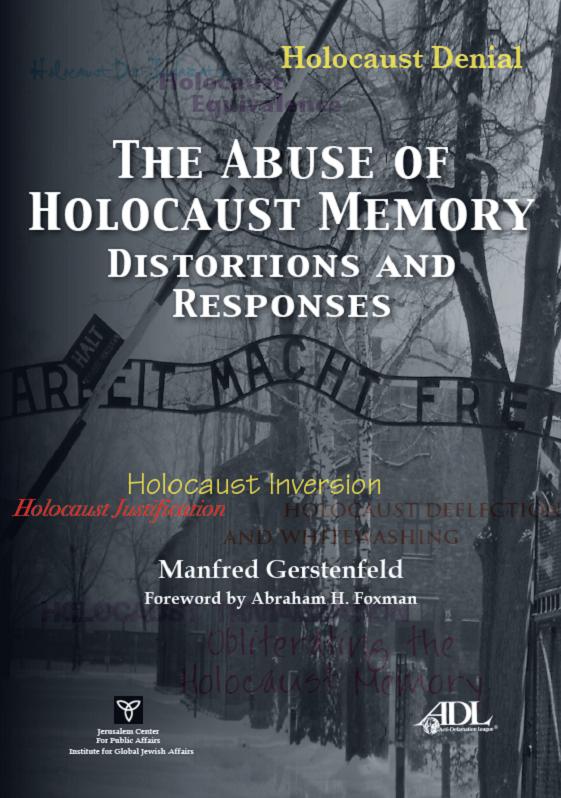
The Abuse of Holocaust Memory: Distortions and Responses
Published by the Jerusalem Center for Public Affairs - Institute for Global Jewish Affairs and the Anti-Defamation League
THE BOOK IS NOW AVAILABLE FOR FREE
In an increasingly
uncertain world, the Holocaust is likely to continue to play an
important role as the metaphor of absolute evil. This is all the more so
as threats of genocide again appear in public statements. Fighting the
main manipulations of the Holocaust requires first understanding the
nature of the abuses. This must be followed by exposing the
manipulations of the perpetrators, who should then be turned into the
accused.
Over the past several
decades, awareness of the Holocaust in the Western world has increased
greatly. Many of its aspects are cited accurately. The broad superficial
familiarity with the subject, however, also makes it prone to a
multitude of distortions. Its history and terminology are abused for a
variety of purposes, including using it as a tool against one's enemies
and, in particular, Jews and Israel.
Denial of the
Holocaust is the best-known and most-studied distortion of its memory.
Other categories of abuse include Holocaust justification, deflection,
whitewashing, de-Judaization, equivalence, inversion, and
trivialization, as well as obliterating Holocaust memory.
Preserving Holocaust
memory correctly requires documentation; education; the establishment of
monuments, museums, and memorials, ceremonies and remembrance days; as
well as commemorative projects. Legislation and art are other spheres
that have made important contributions.
This book analyzes the
categories of distortion and the responses to them. Also included are
case studies that analyze Holocaust distortion in several European
countries and the Muslim world.
Recommendations
Written with exemplary
tenacity, research and courage, this volume's urgency is proven by its
resolve to unmask and denounce the nefarious ugliness of Holocaust abuse
and denial.
Elie Wiesel
Manfred Gerstenfeld offers a much needed study of the myriad of
ways in which the memory of the genocide of the Jews during World War II is being manipulated and distorted in modern discourse. This volume demonstrates that words do matter, and especially language and symbolism surrounding the Holocaust, today's embodiment of supreme evil.
ways in which the memory of the genocide of the Jews during World War II is being manipulated and distorted in modern discourse. This volume demonstrates that words do matter, and especially language and symbolism surrounding the Holocaust, today's embodiment of supreme evil.
Michael J.
Bazyler, professor of law and the "1939" Club Law Scholar in Holocaust
and Human Rights Studies, Chapman University School of Law, California.
This important, timely, and well-written book draws our attention to one of the most pernicious aspects of the contemporary debates surrounding the Shoah: the unrelenting attempts to lessen, distort, deny, or relativize the meaning of this greatest tragedy in human history.Gerstenfeld's book is a powerful reminder that the struggle for historical truth is an ongoing and uphill battle.
This important, timely, and well-written book draws our attention to one of the most pernicious aspects of the contemporary debates surrounding the Shoah: the unrelenting attempts to lessen, distort, deny, or relativize the meaning of this greatest tragedy in human history.Gerstenfeld's book is a powerful reminder that the struggle for historical truth is an ongoing and uphill battle.
Jan Grabowski, professor of history, University of Ottawa
Recent years have
shown that Holocaust memory and commemoration are now often being
manipulated and abused in ways that are anti-Semitic or close to it. In
this important and sometimes distressing book, Dr. Gerstenfeld and other
contributors offer analytical tools to discern and understand this
phenomenon and suggest ways to counter it.
Prof. Dan Michman, chief historian, Yad Vashem; chair, Finkler Institute of Holocaust Research, Bar-Ilan University
With the new
understanding of the Shoah as a unique break in civilization, its use as
an instrument in the battle about memory has intensified. Manfred
Gerstenfeld analyzes these new types of manipulations and at the same
time gives insight into reactions to the universalization of Holocaust
memory.
Dr. Heidemarie Uhl, Austrian Academy of Sciences
Table of Contents
Acknowledgments ........................................................................................................ 9
Abraham H. Foxman: Foreword ................................................................................11
Introduction
................................................................................................................
15
Chapter One: Categories of Distortion ........................................................................ 23
Chapter Two: Holocaust Justification and Promotion ................................................... 33
Chapter Three: Holocaust Denial ................................................................................ 47
Chapter Four: Holocaust Deflection and Whitewashing ............................................... 60
Chapter Five: Holocaust De-Judaization ..................................................................... 79
Chapter Six: Holocaust Equivalence ............................................................................ 90
Chapter Seven: Holocaust Inversion: The Portraying of Israel and Jews as Nazis ........ 101
Chapter Eight: Holocaust Trivialization ...................................................................... 116
Chapter Nine: Obliterating Holocaust Memory .......................................................... 129
Chapter Ten: The Importance of Apologies ............................................................... 136
Chapter Eleven: What Can and Should Be Done? .................................................... 151
ESSAYS AND INTERVIEWS
Manfred Gerstenfeld: Europe's Distortion of the Meaning of the Shoah's Memory and Its Consequences
for the Jews and Israel, an interview with Shmuel Trigano ...........................................175
Mikael Tossavainen: The Holocaust in Arab Public Discourse:
Historicized Politics and Politicized History ............................................................... 184
Susanne Y. Urban: Representations of the Holocaust in Today's Germany:
Between Justification and Empathy ........................................................................... 196
Manfred Gerstenfeld: The Destruction of the Memory of Jewish Presence in Eastern Europe;
A Case Study: Former Yugoslavia, an interview with Ivan Ceresnjes ......................... 207
Dave Rich: The Holocaust as an Anti-Zionist and Anti-imperialist Tool
for the British Left..................................................................................................... 218
Index ...................................................................................................................... 231

