
|
 |
| 19 Jan 2012, Issue 3302 · USD: 1.5243 EUR: 1.95583 · Sofia: min -4°, max 1° Varna: min 1°, max 6° · |
| BUSINESS POLITICS WORLD SOCIETY SPORTS FORUM |
Bulgarian President's Approval Rating Lags Behind Successor's - Poll
 Bulgaria's
outgoing President Georgi Parvanov has an approval rating of 45% at the
end of his second and last term in office, according to a poll
conducted by the National Center for Study of Public Opinion (NZIOM).
read Bulgaria's
outgoing President Georgi Parvanov has an approval rating of 45% at the
end of his second and last term in office, according to a poll
conducted by the National Center for Study of Public Opinion (NZIOM).
read |
US Ambassador to Bulgaria: Do You Really Want to Chase Away Chevron?
 Bulgaria
should think twice before expelling US energy giant Chevron from its
territory, American Ambassador to Bulgaria James Warlick has stated.
read Bulgaria
should think twice before expelling US energy giant Chevron from its
territory, American Ambassador to Bulgaria James Warlick has stated.
read |
WikiLeaks: Bulgaria's Chief Mufti Is Credible Voice
 Bulgaria's
Chief Mufti, Mustafa Hadzhi, who was exposed one day earlier as an
agent of the former Communist State Security, DS, was seen by the
American Embassy in Sofia as a "credible voice among the Muslim
community.read Bulgaria's
Chief Mufti, Mustafa Hadzhi, who was exposed one day earlier as an
agent of the former Communist State Security, DS, was seen by the
American Embassy in Sofia as a "credible voice among the Muslim
community.read |
||
 | ||||
BULGARIA ADOPTS TOTAL BAN ON HYDROFRACKING FOR SHALE GAS IN U-TURN DECISION
Bulgaria's Parliament has voted overwhelmingly in favor of banning the controversial technology of hydraulic fracking (hydrofracking) for shale gas exploration and extraction. The ban on hydrofracking, which comes after mass protests over its potential environmental effects, was approved after four hours of debates Wednesday afternoon with 166 votes in favor, and six votes against. The total ban came after the ruling center-right party GERB and Prime Minister Boyko Borisov made an U-turn on their policies, which originally provided for granting US corporation Chevron a permit for shale gas exploration in Northeastern Bulgaria. The ban on hydraulic fracking was thus endorsed Wednesday by MPs of the ruling party GERB and most of the opposition; only six MPs from the rightist Blue Coalition led by former Prime Minister Ivan Kostov voted against the ban saying Bulgaria needed to be aware of whether it has opportunities for industrial extraction of shale gas; three other MPs abstained. Represenatives of environmentalist and civic NGOs, who protested vigorously against shale gas exploration and extraction in Bulgaria in the recent weeks, were present in Parliament, and applauded the vote of the MPs. The Bulgarian Parliament effectively banned the application of shale gas extraction technologies that bear any resemblance to hydraulic fracking described as the injection of a mix of water and chemical substances underground under a pressure of more than 20 atm for the purposes of exploration or extraction of oil and natural gas on the territory of the Republic of Bulgaria. Those entities who might be found responsible of using hydraulic fracking in Bulgaria would face a fine of BGN 100 M under the new decision of the Parliament. Furthermore, the Bulgarian Parliament gives any physical or legal persons that have already been granted a permit for exploration or extraction of oil and gas a three-month period to present for approval their working projects, thus demonstrating that they do not employ hydrofracking technologies. Those who fail to comply with the deadline, or whose projects are deficient in that respect, are to lose their concession rights. Acting on the motion of GERB MP Valentin Nikolov, deputy head of the GERB parliamentary group and of the Parliament Energy Committee, the Parliament decided that the hydrofracking ban in Bulgaria and its Black Sea zone will be permanent, and unlimited in time. 
BELGIUM ACCUSES BULGARIA, ROMANIA OF UNDERCUTTING ITS LABOR MARKET Bulgarians and Romanians are ready to work for very low wages in Belgium, thus undercutting the local labor market, according to Belgian State Secretary for Repression of Fiscal and Social Fraud John Crombez. Crombez's first task at his new office will be to cope with the problem that employees from the two EU newcomers are posing, according to local media. Currently, some 5343 Bulgarians are living in Belgium, compared with just 892 in 2007, when the country joined the European Union. The number of Romanians residing in Belgium has grown from 5193 to 23 204 over the last five years. Bulgarians and Romanians working in Belgium are most frequently employed in the fields of construction, agriculture and healthcare. Crombez considers tightening the control when it comes to companies hiring foreign workers, Belgian newspapers have reported. Belgium is among European Union member states that officially prolonged the temporary ban on Bulgarian and Romanian workers for two more years, until the beginning of 2014. Currently, Bulgarians have full labor rights in Denmark, Estonia, Cyprus, Latvia, Lithuania, Poland, Slovenia, Slovakia, Finland, Sweden, Hungary, Greece, Spain, Portugal and the Czech Republic, and now Italy. BULGARIA COURTS PORT HAMBURG, MUNICH AIRPORT AS CONCESSIONAIRES During a visit in Berlin with PM Boyko Borisov, Bulgarian Transport Minister Ivaylo Moskovski has reiterated Bulgaria's hopes to get major German companies as concessionaires of transport hubs such as ports and airports. "Bulgaria expects German operators to bid for the concessions of airports and ports in Bulgaria," Moskovski told businesspeople at the German Committee on Eastern European Economic Relations on Wednesday. The Bulgarian Transport Minister revealed the Bulgarian government is holding talks with the Munich Airport for the concessions of airports in Bulgaria, and the Hamburg Port and Logistics Company, the operator of Germany's major port, over Bulgarian ports. In December, during another visit in Germany, Moskovski explicitly invited Hamburg Port and Logistics Company to consider the concession of the Bulgarian Port Varna on the Black Sea. "Bulgaria traditionally works well with German companies in the transport sector," Moskovski told the German Committee on Eastern Economic Relations, reiterating the plans of the Bulgarian Cabinet to open for concessions several Black Sea and Danube ports as well as major airports. German transport company Fraport is already a major German concessionaire in Bulgaria. The airports in Black Sea cities Varna and Burgas have been granted on concession to Fraport Twin Star Airport Management company, a German-Bulgarian consortium between the Varna-based TIM group's holding "Chimimport" (40%) and the German "Fraport", since 2006. In 2010, Fraport Twin Star Airport Management paid the Bulgarian state a total of BGN 13 M for the concessions of Varna Airport and Burgas Airport, which slightly less than the BGN 14 M profit made by state-run Sofia International Airport. Sofia Airport, however, has more passengers than Varna and Burgas combined. BULGARIA TO START PAYING BACK DEBT FOR SIEMENS DESIRO ELECTRIC TRAINS Bulgaria will be paying EUR 1 M per month to settle the debt for the Siemens Desiro electric trains it bought in 2005, it emerged after a meeting between Prime Minister Boyko Borisov and German Chancellor Angela Merkel. The issue was on the agenda of a Bulgarian delegation that arrived Tuesday on a two-day visit in Berlin. On Tuesday, Transport Minister Ivaylo Moskovski listed the three options for settling the debt to German bank KfW, among which were using the proceeds from the upcoming privatization of BDZ's Freight Services department, using the money BDZ would obtain under a loan agreement with the World Bank and a debt/equity swap, which he said was the least likely and yet most profitable scenario. It became clear on Wednesday that Germany had not accepted the proposal for a debt-to-equity swap. It was reported that by end-2012, when the government will have wrapped up the privatization of BDZ' Freight Services department, Bulgaria will be prepared to settle its entire debt of EUR 156 M to the KfW bank. According to estimations of Bulgaria's Privatization Agency, as cited by Darik radio, BDZ's freight arm has tangible assets worth over BGN 300 M. "I am sorry that the previous government did not pay the debt when it had a surplus of BGN 3 B but chose to take out a loan instead," Borisov said, commenting on BDZ' liabilities to the German bank. "Now the time has come for us to pay back the debt and we shall pay it. We have no way of not paying it because the unlimited trust of Germany in Bulgaria would be marred. We cannot allow this to happen," Borisov declared. "After the beginning of the structural changes at BDZ in end-2011, the company managed to pay EUR 1 M in overdue debts to KfW," Transport Minister Ivaylo Moskovski said after Wednesday's talks. He explained that the money transfer had indicated Bulgaria's strong commitment and will to tackle the delayed payments. Moskovski assured German Chancellor Angela Merkel and the East German economy committee that BDZ had developed a debt settlement program under which it would pay EUR 10 M by end-2012. "The company very much relies on the revenues from the forthcoming privatization of its freight arm and much of it will go to paying the debt to KfW Bank Group," Moskovski stated. He added that the decision on the loan from the World Bank was also due soon and the money would go to BDZ' rehabilitation. BDZ risks losing the Siemens Desiro electric trains, or half of the fleet of modern passenger trains, unless it moves to settle the debt it owes to KfW for their purchase. The loan, which was taken out in 2005 and has not been serviced since 2010, is partly guaranteed by the German government. WORLD BANK: BRACE UP FOR CRISIS WORSE THAN GFC The World Bank has warned the whole world, but particularly emerging economies, including Bulgaria, of an imminently gloomy 2012 - lower than expected growth, recession in the euro zone and longer and deeper downturns than the last one. The world economy will grow 2.5% this year, down from a June estimate of 3.6%, the Washington-based institution said in its Global Economic Prospects report. The euro area is forecast to contract 0.3%, compared with a previous estimate of a 1.8% gain. The US growth outlook was cut to 2.2% from 2.9%. "Even achieving these much weaker outturns is very uncertain," the World Bank said. "The downturn in Europe and weaker growth in developing countries raises the risk that the two developments reinforce one another, resulting in an even weaker outcome." Emerging markets are more vulnerable than in 2008 to a renewed global crisis because rich nations wouldn’t have the fiscal resources they had back then to support their economies, the World Bank said. Developing countries, whose deficits have also widened, should engage in contingency planning to have the necessary fiscal leeway if need be, it said. “Should conditions in high-income countries deteriorate and a second global crisis materializes, developing countries will find themselves operating in a much weaker global economy, with much less abundant capital, less vibrant trade opportunities and weaker financial support for both private and public activity,” the World Bank said in the report. BULGARIA PRESSURED TO INVEST IN GREEN ENERGY - PM Bulgaria is under a huge pressure to invest in green energy, the country's Prime Minister Boyko Borisov stated during his visit to Germany. Borisov stated that his country's legislation on green energy had to be altered twice in order to deal with "attacks" concerning projects worth billions of Euro. Bulgaria has already reached its renewable energy quota set for 2020, the Prime Minister believes. He pointed out that renewable energy capacities of 2000 MW are currently being installed in Bulgara, with 800 MW more being approved of. However, he declared that the green energy expansion has proved to be too expensive for the poor Bulgarian taxpayer. "I tackled this topic since I know that you will ask me about it. You'd better not ask me, because this is horrible for the Bulgarian taxpayers, who are still the poorest in Europe," Borisov said, as cited by dnevnik.bg. On Wednesday, he met with the management of the Committee on Eastern European Economic Relations. During the meeting, the Bulgarian Prime Minister reiterated that his country seeks to attract investors who can create jobs and increase its high-value added export-oriented production. RWE MAY RECONSIDER NABUCCO PARTICIPATION RWE AG may pull out of the Nabucco gas pipeline project aimed at carrying natural gas from the Caspian region to central Europe via Turkey, according to the German utility's chief executive. While still keen to import Caspian gas to Europe, RWE favors options "that keep our own financial exposure limited," said Chief Executive Juergen Grossmann in an interview for The Wall Street Journal Deutschland. RWE, which has been badly hit by the German retreat on nuclear power, could support other pipelines that have competed with Nabucco, he added. The German government's nuclear retreat and a tax on nuclear fuel triggered billions of euros in extra charges for the utilities, which cut investment and pledged to conserve cash in response. RWE was forced to moved ahead with an asset disposal program and to reiterate vows to reduce investment and increase savings. If the German energy giant scraps plans to participate in the Nabucco project, it could save a significant amount of cash. RWE's main priority is to source gas with as little investment as possible, the company's CEO explained. "The important thing is that Caspian gas flows to Europe and that it arrives in the quantities, and where, we need it," Grossman specified. Whether the pipeline is called "Nabucco or Turandot doesn't really matter to us," he said in reference to the operas by Italian composers Giuseppe Verdi and Giacomo Puccini. Grossman's remarks are the first concrete signal from a member of the Nabucco consortium that the pipeline may not be built, despite years of preparation. Nabucco was named after a Verdi opera after the founding members of the Nabucco consortium listened to Verdi's Nabucco opera at the Vienna State Opera in 2002. The gas pipeline project has long been an EU priority due to hopes that it will diversify gas sources away from the dominant supplier, Russia. The Nabucco shareholders are: Bulgarian Energy Holding (Bulgaria), Botas (Turkey), FGSZ1 (Hungary), OMV (Austria), RWE (Germany), Transgaz (Romania). Each shareholder holds an equal share of 16.67% of Nabucco Gas Pipeline International GmbH. 
US AMBASSADOR TO BULGARIA: DO YOU REALLY WANT TO CHASE AWAY CHEVRON? Bulgaria should think twice before expelling US energy giant Chevron from its territory, American Ambassador to Bulgaria James Warlick has stated. In an interview for the Nova TV private channel, Warlick pointed out that Chevron could pour millions of USD in investments in Bulgaria and create jobs if it is not stopped from researching the country's shale gas deposits. The Ambassador pointed out that Chevron has no other interests in Bulgaria besides shale gas and would be forced to leave the country if its opportunities are curbed. He added that the company is doing business all over the world and is not desperate to work in the Balkan country. Even though the US diplomat admitted that no completely safe ways for extracting energy exist, he reminded that Chevron has explored many shale gas deposits all over the world in a reliable manner. Bulgaria's parliament will vote on Wednesday the proposed ban on the use of hydrofracking technology in the extraction and exploration of gas and oil in Bulgaria. The text is included in a draft proposal of the Parliamentary group of the ruling, center-right Citizens for European Development of Bulgaria party, GERB. The proposal points out that the ban includes the use any technology involving the propagation of fractures in a rock layer caused by the presence of pressurized water or other fluid. It also bans extraction of shale gas, gas from coal, and of oil from sands on the territory of the Republic of Bulgaria and its territorial waters. On Saturday, the latest in the series of environmental protests took place in several cities across Bulgaria, with thousands of citizens gathering to rally against what they see as a great environmental danger posed by the potential use of the hydrofracking technology for shale gas exploration and extraction in the northeastern parts of the country. MAJOR BULGARIAN TPP TO SWITCH TO BROWN COAL OVER MINING STRIKE Bulgaria's Maritsa Iztok 2 Thermal Power Plant has conducted a successful experiment with burning brown coal from the Pernik basin. The test was conducted as the Maritsa Iztok Mines, which went on strike on Sunday evening, cut coal supplies to the TPP. In 4 hours, 200 tons of coal were burned at cauldron 12 of Block 8 of the TPP. The monitoring of the technological process showed an optimal burning of the energy source. The experiment proved that the characteristics of brown coal are in line with the systems at the TPP's cauldrons and are a good alternative to the ones used so far. The capacity of Block 8 of Maritsa Iztok 2 has remained unchanged. The efficiency of the sulphur purification facility of the unit has increased because this type of coal has a lower sulphur content, below 1%. The Maritsa Iztok 2 TPP will start receiving supplies from the St Elizabeth mine in the Pernik coal basin, whose concessionaire is Belgian Rekoul AD. Maritsa Iztok 2 will initially receive 1000 tons per day but the quantities will be gradually increased and burned in all cauldrons of the TPP. STRIKE AT BULGARIA'S MARITSA IZTOK MINES ENTERS DAY 4 The strike at Maritsa Iztok Mines AD has so far brought losses of BGN 4 M for the company, according to Evgeni Stoykov executive director of the state-owned coal mining company. The production process at the company was suspended on Sunday evening due to a termless strike of the workers. The 7100 employees of Maritsa Iztok Mines AD insist that they be paid bonuses of BGN 1000 for the record output achieved in 2011 in line with an agreement signed on July 12, 2011. The syndicates at Maritsa Iztok Mines AD insist that the employer comply with the document regulating the relative share of the wage costs in relation to the company's revenues. They claim that Evgeni Stoykov withdrew his signature from the agreement despite the anticipated BGN 500 M in revenues of the company, thereby leaving the miners without year-end bonuses. The management of Maritsa Iztok Mines AD, however, has said that it has fulfilled all of its commitments under the agreement. The negotiations between the management of the company and the syndicates, which have dragged on for over a month, have so far failed to bring a resolution to the dispute. Prime Minister Boyko Borisov has sided with the company's governing body, saying that the miners were better paid than the Finance Minister. According to the joint Strike Committee of Bulgaria's two main labor unions – the Confederation of Independent Syndicates in Bulgaria, KNSB, and the Podkrepa Labor Confederation (Support), over 90% of the workers on duty joined the strike on the fourth day. According to the managing body of Maritsa Iztok Mines, however, a total of 2300 of the 2960 workers on duty, or 77%, were involved in the strike. Angel Semerdzhiev, Chair of the State Energy and Water Regulatory Commission (DKEVR), warned on Tuesday that power prices would rise by at least 10% from July 01 2012 unless the miners went back to work in a month. The three open-pit mines at Maritsa Iztok Mines AD supply coal to four thermal power plants, whose output covers 25% of the country's electricity needs. WIKILEAKS: BULGARIA'S CHIEF MUFTI IS CREDIBLE VOICE Bulgaria's Chief Mufti, Mustafa Hadzhi, who was exposed one day earlier as an agent of the former Communist State Security, DS, was seen by the American Embassy in Sofia as a "credible voice among the Muslim community." The information comes from a cable, sent in 2007 by John Beyrle, US Ambassador to Bulgaria before going to Moscow, to the US State Department. It was released by WikiLeaks and their official Bulgarian partner, the site for investigative journalism Bivol.bg, in the aftermath of Bulgaria publishing the names of senior clergy that collaborated and spied for DS. The cable, classified "sensitive," was written in response to a mandate from Washington to Embassies worldwide to identify "credible voice among Muslim communities that reject violence." According to Beyrle, "Hadji is a moderate; has a generally positive view of the United States; and does not have any known disagreements with US policy." The cable focuses on the Mufti's biography and his influence among Bulgarian Muslims (ethnic Turks, Roma, Pomaks - descendants of Slavic Bulgarians who converted to Islam under Ottoman rule). The cable also notes unconfirmed rumors that he had been a collaborator of the Communist State Security. The latter is probably a reference to the unofficial exposure of Hadzhi and several other known personalities as agents in 2006 by now former Interior Minister, Rumen Petkov – he said then that the Mufti's file had been destroyed - a statement included in another US secret cable, Bivol writes. The Files Commission – the panel investigating the Communist Era files, announced that Hadzhi's file, with the alias "Andrei," had been indeed destroyed. Bivol's search and publications from the WikiLeaks database of a number of cables, sent from the US Embassy in Sofia, show that American diplomats have followed very carefully the subject with the DS files, and regularly reported on exposed DS agents among senior officials. US intelligence had been aware, for example, about outgoing President Parvanov's DS past, even before it was revealed for the record. In 2006, Ambassador Beyrle had noted that only those with sufficient hold on power will be able to keep their DS files secret, and stressed that the files make no difference between redemption and the lack of such. Meanwhile, speaking for the Bulgarian National Radio, BNR, Wednesday, Hadzhi adamantly denied ever having anything to do with DS. A check of Bivol of the WikiLeaks cables database had not found anything on the DS past of the members of the Holy Synod at the Bulgarian Orthodox Church. Full text of the cable read HERE and HERE. BORISOV: SLEEP CALM, GERMANY, BULGARIA GUARDS YOUR BORDERS The Bulgarian-Turkish border is the best protected external EU border, Bulgarian Prime Minister Boyko Borisov has told German Chancellor Angela Merkel in Berlin. "That's why you can sleep calm," the Bulgarian PM told the people of Germany at his joint news conference with Angela Merkel on Wednesday, as cited by DPA> After Bulgaria's hopes to join the visa-free Schengen Area were frustrated in 2011 by the vetoes of the Netherlands and Finland, amidst concerns by other EU member states such as France and Germany, during his meeting with Merkel Borisov sought to emphasize that in the past few months Bulgaria has met absolutely all criteria for protecting the external borders of the EU and the Schengen zone. The German Chancellor herself has recognized the fact that Bulgaria has made considerable progress in meeting the Schengen membership criteria. He position is seen as raising Borisov's hopes that Bulgaria will soon be admitted to the "borderless" Schengen Agreement, according to the reports of German media. "Some of the member states aren't convinced in that but all of them want to find a way. I think that the time when Bulgaria will be part of Schengen is not so far ahead in the future. Bulgaria needs to do as much as possible to cope with corruption and border security," Merkel told Borisov, while also noting that Bulgaria's Schengen accession needs further discussions within the EU. Borisov himself has noted that he expects that even the Netherlands, the EU state with the staunchest veto, will soon be convinced of Bulgaria's Schengen fitness. BULGARIAN PM INSISTS IN BERLIN ON EU BENEFITS FOR FISCAL DISCIPLINE The EU does not stimulate in any way the fiscally responsible countries such as Bulgaria, Bulgarian Prime Minister Boyko Borisov complained before German businesspeople at a meeting with the German Committee on Eastern European Economic Relations. Borisov, who went to Berlin for talks with German Chancellor Angela Merkel Wednesday, has reiterated his earlier complaint by stressing that EU member states who failed to obey the Union's fiscal requirements have been entitled to much smaller share of co-financing for EU funded projects, while Bulgaria, which has the lowest GDP per capita and is fiscally responsible, has to co-finance a lot more. "You are not stimulating us to be financially disciplined," Borisov told the German Committee on Eastern European Economic Relations, stressing that he will insist before Merkel that Bulgaria too is entitled to co-finance EU funded projects with only 5% like Greece, and Portugal, and not with 20%, as it is at present. "What am I supposed to tell the opposition when they ask me why we need to obey strict fiscal discipline? Bulgaria is one of three countries in the EU with the best fiscal discipline. In spite of that, it turns out that it's better to have a high public debt and budget deficit because they you get support," Borisov complained in Berlin, as cited by Focus. "Your comments will be very interesting for me. I am in a tough spot with my opposition. We don't demand any additional money, just equal conditions in EU funding for the most disciplined states and the most troubled states," he explained. "Because it turns out it is better to be a populist, to raise the debts and deficit, instead of keeping the requirements," he added. According to Borisov, if Bulgaria is allowed to co-finance EU funded projects with only 5% of the total sum, that will allow the Bulgarian government to redirect about BGN 500 M to other spheres. Borisov's meeting with the German Committee on Eastern Economic Relations also focused on investments, green energy, and e-government, among other topics. As early as December 2011, there were reports that Bulgaria, the poorest EU member state, feels cheated as the EU institutions were to approve a new policy allowing six other member states, which are struggling financially, to be able to co-fund projects with much less money. The European Commission proposed last summer to increase the EU co-financing in cohesion, fisheries and rural development policies for countries that have received financial assistance under the balance of payments support mechanism - Romania, Latvia and Hungary - or under the European Financial Stability Facility - Greece, Ireland and Portugal. For example, the EC will provide a maximum of 95% project financing in the case of Greece – from a previous 78% . The Greek government would not need to provide the 15% usually requested to member states, but only up to 5% of the cost of a project. Although Bulgaria is the poorest EU country, it is excluded from the beneficiaries because its macroeconomic indicators are stable. BULGARIAN PM: WHEN MERKEL TALKS, I LISTEN Bulgaria will seek support from Germany for decreasing the percentage of its national co-financing of EU fund projects from 20% to 5%, Bulgaria's Prime Minister Boyko Borisov has revealed. Ahead of his Wednesday meeting with German Chancellor Angela Merkel in Berlin, Borisov reiterated that his country does not intend to contribute a greater percentage in national funds to co-financed EU projects than the more fiscally undisciplined member states, adding that Merkel's support would be crucial in achieving that. "Bulgaria is among the three most disciplined states in Europe," Borisov pointed out late on Tuesday, as cited by the Bulgarian Telegraph Agency. He explained that this potential measure could spare some BGN 600 M to BGN 700 M from Bulgaria's state budget, which can be used for research and innovations. "Unlike other Prime Ministers, when the Chancellor speaks, I listen – and then we implement in Bulgaria the appropriate decisions suggested," the Bulgarian Prime Minister declared, pointing out his country's low budget deficit, low foreign debt and low inflation rate. "That is why we are respected," he added. EU ISSUES WARNING FOR HUNGARY OVER MEDIA FREEDOM The European Union has warned Hungary over its media freedom, adding to mounting international pressure over controversial Hungarian legislation changes and practices. The EU's digital agenda commissioner, Neelie Kroes, wrote to Hungarian Justice Minister Tibor Navracsics overnight into Wednesday to "stress that the respect of media freedom and media pluralism is not only about the technically correct application of EU and national law." It is "also, and more importantly, about implementing and promoting these fundamental principles in practice," she added, warning that the European Commission "will remain particularly vigilant on those aspects." The EC letter followed the non-renewal of broadcasting licenses held by the liberal commercial radio station Klubradio, which is known for its critical stance towards the Hungarian government of Prime Minister Viktor Orban. "Why we sent the letter now? Obviously Mrs Kroes has an ongoing concern and we have been receiving information in recent days suggesting we might have a reason for increasing concern," her spokesman, Ryan Heath, told reporters in Brussels, as cited by DPA. In an earlier email, he had also pointed to continuing domestic and international criticism of "the risks of disproportionately centralized control of media under Hungary's media law." The law was amended under pressure from the commission, but it remains "without precedent in other EU jurisdictions," Heath noted. "The (EU) Charter of Fundamental Rights is very clear: you have to respect media freedom and pluralism. We are closely looking at the situation. We are not dropping the ball," he said. Hungary is already facing three infringement proceedings from the European Commission over recently approved reforms that affect its central bank, its data protection authority, and its judiciary. The EU has recently also delayed the launch of aid talks with the cash-strapped country, rapped Budapest over its excessive government deficit, and ordered it to reclaim illegal state aid to national airline Malev, DPA reminds. ORBAN TELLS EU NOT TO WORRY ABOUT HUNGARY'S 'RENEWAL' ISSUES Hungarian Prime Minister Viktor Orban has reacted to EU criticism of his government's controversial legislative and executive moves by seeking to assuage concerns before the European Parliament. Orban told European Union lawmakers in Strasbourg Wednesday that fixing the issues which led the bloc's executive to launch legal proceedings against his country "will not pose a problem," as cited by DPA. At the same time, he urged the EU to take into account that his country is undergoing a "serious transformation after being on the brink of collapse" two years ago. "What's happening in our country is a very exciting process of renewal," Orban said at the European Parliament's plenary in Strasbourg, France. "It is absolutely understandable that there are debates in conjunction with that," he added. As far as the European Commission's infringement proceedings go, Orban said that "remedying these ... concerns will not pose a problem" and that Hungary is "at your disposal for that." His statement at the EP comes after earlier on Wednesday the European Union warned Hungary over its media freedom, adding to mounting international pressure over controversial Hungarian legislation changes and practices employed by the governing center-right Fidesz party, with EU digital agenda commissioner, Neelie Kroes, wroting to Hungarian Justice Minister Tibor Navracsics. BULGARIAN PRESIDENT'S APPROVAL RATING LAGS BEHIND SUCCESSOR'S - POLL Bulgaria's outgoing President Georgi Parvanov has an approval rating of 45% at the end of his second and last term in office, according to a poll conducted by the National Center for Study of Public Opinion (NZIOM). Curiously, Parvanov's approval rating has virtually reached the same level as the one he had when he took over as President 10 years ago (45%), the pollsters have observed. He had a significantly higher rating at the end of his first term, when nearly 66% of poll respondents approved of him. President-elect Rosen Plevneliev, the former Regional Development Minister in ruling centrist-right GERB's cabinet, enjoys an approval rating of 55% prior to assuming office, the same poll has shown. Bulgaria's President-elect and Vice President-elect, Rosen Plevneliev and Margarita Popova, will take the oath of office before the National Assembly on Thursday. The official ceremony for the inauguration of the new President of Bulgaria will be held on Sunday, January 22. BULGARIAN PM FACES LIBEL LAWSUIT OVER TAPEGATE SCANDAL Journalist Yavor Dachkov has said he plans to file a lawsuit for libel against Prime Minister Boyko Borisov by the end of the week. During a Wednesday press conference, Dachkov said he would file a civil lawsuit against Borisov over the Prime Minister's claims that Dachkov was involved in the manipulation of leaked phone conversations. The "Tanovgate" scandal flared up in early January 2011, when the Galeria weekly, where Dachkov is Deputy Editor-in-Chief, released three tapes of discrediting conversations between Prime Minister Boyko Borisov, Customs Agency head Vanyo Tanov, Finance Minister Simeon Djankov, and Deputy Finance Minister Vladislav Goranov. In one of the conversations Borisov was heard ordering Tanov to immediately pull out customs inspectors out of the "Ledenika" brewery owned by Mihail Mihov because he had promised the businessman not to bother him. Mihov died on March 30, 2011 after suffering a severe heart attack. During Wednesday's press conference, Dachkov explained that the tapes had been made using special surveillance devices and had not been manipulated, which had been proved by a number of different expert statements. The journalist insisted that the tapes were authentic surveillance data gathered by the Interior Ministry during an investigation of Tanov. He argued, however, that the tapes had been accessible for officials of the State Agency for National Security (DANS), who had recorded them using a simple sound recording device. Dachkov suggested that the events had been part of a racketeering scheme which had been practiced for years by the top brass at DANS to exert pressure over businessmen and politicians. He further claimed that the Deputy Director of DANS and the former Director of the service had been fully aware of the scam and had taken advantage of it. Dachkov vowed to seek a huge compensation for the slander. BULGARIA HAPPY TO HONOR ST ATHANASIUS HALF PAST WINTER The Bulgarian Orthodox Church celebrates on January 18 the Day of Saint Athanasius (Atanasovden), who is the ruler of snow and ice. The holiday is said to mark the middle of winter. According to traditional Bulgarian beliefs, once the Day of Saint Athanasius is over, the spring is near. Atanasovden, like St. Antony's Day, is a holiday of the blacksmiths, ironmongers, cutters and shoeing smiths, as well as a holiday to show respect to those who are ill. Therefore, early in the morning women would bake a small flat loaf of bread, decorated with two dogs, who keep the diseases away from people. Those who bear the name of the saint (Atanas) also celebrate on January 18. BULGARIA'S STOICHKOV MAKES DREAM COME TRUE FOR TEEN COMA SURVIVOR Hristo Stoichkov, Bulgaria's most internationally renowned football player, made the dreams of a very sick boy come true on Wednesday, when he surprised 13-year-old Tanyo in hospital, just weeks after his liver transplantation. Tanyo Kostov was blessed with a second chance at life after Bulgarian authorities and Sofia-based hospital Lozenets pooled their efforts to rescue the boy from Athens, where he lives with his family. Beset by the Wilson disease, a genetic disorder that prevents the body from getting rid of extra copper, the boy fell into coma last month. The only chance for life was a liver transplantation, which however the Greek doctors refused to do since there were no matching dead donors.  Unlike
Greece however Bulgaria makes liver transplantations from live
donors, which is why the boy was urgently flown to Sofia with the
assistance of Bulgaria's embassy in Athens and the government. Unlike
Greece however Bulgaria makes liver transplantations from live
donors, which is why the boy was urgently flown to Sofia with the
assistance of Bulgaria's embassy in Athens and the government.A team from Sofia-based University Hospital for Active Treatment Lozenets committed to the risky operation, a daunting task for any surgeon. The moral burden on the doctors' backs got heavier after the father agreed to become a donor so that his son may live. "The surgery was a big challenge for us, not only because it is very complicated and risky. The biggest moral dilemma I faced was posed by the healthy father, who without hesitation agreed to donate half of his liver. That was a great challenge and responsibility for us," Dr. Lyubomir Spasov, head of the Lozenets University Hospital, shared. The chance for Tanyo to survive was less than 10%, but the medics decided to take the risk. Less than a month after the lifesaving procedure, Tanyo, with a wide and welcoming smile on his face, stood before reporters at a press conference on January 18, next to his idol Stoichkov. Stoichkov had gotten wind of Tanyo's plight, and, hearing that his dream was to one day meet him, hooked up with the government and the hospital to make this dream come true. "This is the least I can do. There is no greater award for me than to see one little child, now that he has a second chance at life, happy again," an emotional Stoichkov told reporters. 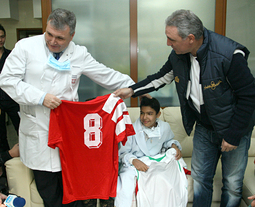 In
addition to spending a genuine amount of time with Tanyo, the
football legend presented him with a few precious gifts that may ignite
envy in any football fan - a T-shirt of the national team, a present
from the great Pele, a football ball and shoes. In
addition to spending a genuine amount of time with Tanyo, the
football legend presented him with a few precious gifts that may ignite
envy in any football fan - a T-shirt of the national team, a present
from the great Pele, a football ball and shoes."Bulgaria should be proud that it has doctors who have saved the life of this boy and fathers, who dare to risk their lives so that their children can live. This is the biggest success any nation can achieve," Stoichkov said. Also in attendance were Tanyo's father, who became his donor, mother and little sister. "I want to thank the team and the whole hospital for saving the life of my son, for doing two risky operations on my son and my husband and for having them both alive here with me," the mother said, as she broke down, overwhelmed by tears. For his new life the boy has just one wish. "When I grow up, I want to become a football player, just like Hristo Stoichkov." BULGARIA'S PIRONKOVA KICKED OUT OF AUSTRALIAN OPEN Bulgaria's highest-ranked female tennis player Tsvetana Pironkova lost to Galina Voskoboeva of Kazakhstan on Wednesday and failed to get past the second round at the Australian Open Grand Slam tournament. Pironkova, who ranks 47th in the world and is unseeded, was defeated by Galina Voskoboeva of Kazakhstan 4:6, 4:6 in a match that was mundane by any measure. Pironkova reached the second round after expectedly defeating Sania Mirza of India in 88 minutes, 6-4, 6-2. The Bulgarian has never reached the third round at Australian Open in her career. Oddly, Pironkova's only winning record at the four major international championships has come at Wimbledon - she reached the Wimbledon semifinals in 2010 and quarter-finals last year although she struggled at other Grand Slams. BULGARIA'S PIRONKOVA 9TH IN BLEACHER REPORT 'SPORTS HOTTIES' RANKING Bulgarian tennis star Tsvetana Pironkova has been ranked 9th among "The 25 Most Photogenic Sports Hotties" by The Bleacher Report. "Meet Tsvetana Pironkova, the Bulgarian beauty. She might not have the press coverage of some of the other popular female tennis stars, but her beauty will not go unnoticed in 2012. Get ready for a year of the Tsvetana," The Bleacher Report says in its brief description. In the "Sports Hotties" ranking, the top Bulgarian tennis player Pironkova even beats Russia's Maria Sharapova, who is ranked 17th. The top three sports in the ranking are for UFC ring girl Arianny Celeste, Anna Kournikova, and golf player Sophie Horn. DIMITROV FALLS SHORT OF UPSETTING ALMAGRO AT AUSTRALIAN OPEN Bulgaria's Grigor Dimitrov, world No.78, suffered a dramatic five-set defeat at the hands of Spaniard Nicolas Almagro in the second round of the Australian Open Grand Slam tournament. The Bulgarian lost 6:4, 3:6, 7:6(4). 4:6, 0:6 after sustaining an abductor injury at the end of the fourth set. Thus, the 20-year-old youngster failed to record his first official victory against a top-10 player. After the clash on Wednesday, Almagro spoke highly of his opponent, predicting that he will be seen in the final stages of many major tournaments in the future. RUSSIAN BILLIONAIRES ANZHI SAID TO ENTER BERBATOV CHASE Vastly rich Russian club Anzhi Makhachkala have been the latest bidders linked with Manchester United striker Dimitar Berbatov. Anzhi have joined the chase as they seek a strike partner for Cameroon star Samuel Eto'o, according to The Daily Mail. Bayer Leverkusen, the club that once witnessed Berbatov's raise to prominence, as well as Bayern Munich, are said to be the other two teams eager to snap up the Bulgarian. Even though Red Devils boss Alex Ferguson has insisted that Berbatov will be offered a one-year extension in March, rumors continue "sending" the striker to various European clubs. The reports that Berbatov may be on the verge of leaving Old Trafford have been fueled by his alleged recent travel to Germany, as well as the statement on behalf of PSG coach Carlo Ancelotti that he is among the players actively offered by agents on the transfer market. EX MAYOR, MP GOES TO JAIL IN BULGARIA A 3.5-year jail sentence of Fidel Beev, former Mayor of the town of Velingrad and ex Member of Parliament from the ethnic Turkish party DPS, has been confirmed by the Bulgarian Supreme Court of Cassation. Beev, who was a deputy from the ethnic Turkish Movement for Rights and Freedoms (DPS), is sentenced for malfeasance and criminal breach of trust during his term as Mayor of the Southern town of Velingrad. He was found guilty of making an illegal fuel supply contract for municipal kindergartens, thus inflicting upon the municipality a loss of BGN 16 000. Instead of making a contract with a firm that legally took part in a municipal tender, he supplied fuel with a firm of his own, called "Beev Brothers". In addition to confirming his jail sentence, the Bulgarian Supreme Court of Cassation ruled in favor of the demand of the Velingrad Municipality that Beev pay it a compensation of BGN 16 351 as well as the trial expenses. Beev was first sentenced for the fuel supply contract by the Sofia City Court in 2009; he appealed the ruling after that. In 2010, the Supreme Court of Cassation revoked another verdict against Beev in which he was sentenced for beating a man, Kostandin Paskov, at a Velingrad gas station back in 2003. BULGARIA SOFTENS ILLEGAL ASSETS CRACK-DOWN TO TARGET 'REAL CRIMINALS' Bulgarian authorities are likely to have the right to launch probes and seize following an indictment unexplained wealth, worth more than BGN 250,000, which has been acquired over the last ten years. This is envisaged by amendments to the long-delayed bill authorizing widespread confiscation of illegally obtained assets, which were tabled in parliament by the Justice Ministry on Tuesday afternoon. The majority in Bulgaria's parliament surprisingly failed to pass through the keenly expected bill in July last year, triggering fierce criticism in the EU and US, as well as suspicions of a set-up. The draft law, initiated by Bulgaria's former Justice Minister and current Vice President-elect Margarita Popova and widely touted by the ruling party as a powerful tool in crime and corruption combat, initially envisaged that the commission will have the right to launch investigations into incomes and acquisitions for the last twenty-five years and seize assets without conviction. "The new version of the bill seeks to target not the ordinary citizens, but the members of organized crime groups," the recently appointed Justice Minister Diana Kovacheva justified the changes. Analysts however have commented that the period of ten years and the condition for an indictment in place practically will make many people untouchable. The Council of Europe's Venice Commission approved the previous, fifth version of the draft law in the middle of last year and recommended that it enters into force in 2012. The commission called on Bulgaria's parliament to pass the new law by its summer recess. The European Commission, which sees the legislation as a powerful weapon in the country's corruption combat, had set the same deadline. The law will allow the state Commission for Establishing of Property Acquired from Criminal Activity to probe the property and bank account of members of the families of people who cannot explain their sources of income in court and their partners. Donations made in order to hide assets from the commission will also be subject to probes. Under the law transactions with criminally acquired property will be void and subject to forfeiture. So if the holders of illegal assets get rid of them by selling them quickly at low prices, buyers can also be held accountable. The current center-right government of Bulgaria, led by Boyko Borisov, was elected two years ago on an anti-corruption mandate and on the promise to bring to justice those involved in huge-scale corruption schemes. Some embezzlement trials against high-ranking officials have been widely considered to be a litmus test for the government's willingness to do so in practice, but most of them have ended with acquittals. WIKILEAKS: CREDIBLE VOICES IN BULGARIAN MUSLIM COMMUNITIES Click here to read the story: www.novinite.com/view_news.php?id=135822 BULGARIA'S NEW TAX POLICY Bulgaria's finance ministry has proposed a brand new tax return form. It consists of just three lines: 1. How much did you earn last year? 2. How much did you have after paying taxes? 3. Pay the amount specified in line 2. 3 INDEPENDENTS GET ENOUGH SIGNATURES TO CHALLENGE PUTIN Three independent candidates – including billionaire Mikhail Prokhorov, veteran liberal Grigory Yavlinsky and Irkutsk Governor Dmitry Mezentsev – have collected enough signatures to run against Vladimir Putin for the Russian Presidency. Prokhorov, Yavlinsky, and Mezentsev submitted to the Russian Central Election Commission on Wednesday the required minimum two million signatures required to enter the presidential race, just hours before the deadline for independent candidates. Prokhorov, a 46-year-old businessman-turned-politician, said he ruled out "any possibility that the signatures will be recognized as invalid." "I have collected signatures of a high quality. I don't see any grounds for being rejected from registration," Prokhorov said, as cited by RIA Novosti. His election team had collected signatures at railway stations, airports, supermarkets and other public places, a method he claimed had not been used before by other candidates. Prokhorov, who said on Tuesday he might appoint former Russian Finance Minister Alexei Kudrin or jailed tycoon Mikhail Khodorkovsky as prime minister if elected president, said he saw his main rivals as current premier Vladimir Putin and "three Duma elders," A Just Russia party's leader Sergei Mironov, Communist Party head, Gennady Zyuganov and Vladimir Zhirinovsky, the leader of the LDPR party. He dismissed the latter three as "well-concealed Kremlin projects," which merely pretend to be in opposition.. Prokhorov, who is expected to unveil his presidential program on Thursday, repeated his offer to serve as prime minister if Putin wins the presidential race, but only if their programs coincided by 80%. "I won't carry out someone else's program...if our programs coincide by 80 percent, then I'll think about it," he said. Russian President Dmitry Medvedev proposed Putin as candidate for the presidency at the annual United Russia party congress in September. Putin, in response, said Medvedev will get the premier's post if he returns to the Kremlin. The leader of the unregistered Volya party Svetlana Peunova handed in just 234,000 signatures and said she would push for an investigation into the other candidates' signatures since "it is impossible to collect two million signatures without fraud." Under Russia's election rules, candidates proposed by major parties, such as Putin, Zyuganov, Zhirinovsky and Mironov, are not required to collect signatures. RUSSIA TO DO ALL IT CAN TO PREVENT 'WESTERN ATTACK' ON IRAN An "attack on Iran by Western powers" could cause an unpredictable "chain reaction" throughout the region, Russia's Foreign Minister Sergei Lavrov has warned. "It is impossible to list all the consequences [of an attack]. But I have no doubt that it would pour oil on the still smoldering fire of Sunni-Shia confrontation, which would lead to a chain reaction," Sergei Lavrov said in an annual address on Wednesday, as cited by RIA Novosti. "As for how likely such a catastrophe is, you need to ask those who constantly mention this as an option," he added. Lavrov also said that Russia would "do everything" in its power to prevent an attack on Iran. The Russian news agency RIA Novosti points out that although Israeli Defense Minister Ehud Barak said on Wednesday that Israel is "very far off" from taking the decision to strike Iran, Washington and Tel Aviv have refused to rule out military force against Tehran over suspicions that its nuclear program is aimed at the production of atomic weapons. Iran, which recently began enriching uranium at an underground bunker, denies it is seeking nuclear arms and says its program is to provide peaceful civilian energy. Lavrov also said that sanctions on Iranian oil exports being discussed by the European Union would "hurt" ordinary people and were more about stirring up unrest than nuclear non-proliferation. "This has nothing to do with a desire to strengthen nuclear non-proliferation," he said. "It's aimed at stifling the Iranian economy and the population in the apparent hope of provoking discontent," he said, adding that sanctions would also prove "an obstacle" to the revival of a dialog between Iran and the six world powers involved in negotiations on its nuclear program. Oil exports make up some 80 percent of Iran's foreign revenues and Tehran has threatened to close the Strait of Hormuz, the export route for one third of global seaborne traded oil, in response to sanctions. US Defense Secretary Leon Panetta has said such a move would provoke a response. RIA Novosti points out that analysts are doubtful whether Russia has the military and economic clout to play a decisive role on Iran "Russia has practically no real influence left in the Middle East. Iran cannot rely on Russia to defend it. The US and Israel are certainly not afraid of this. Russia will not definitely go to war over Iran," said analyst Sergei Demidenko of the Moscow-based Institute of Strategic Studies and Analysis. SMOKE BOMB SCARE CAUSES WHITE HOUSE LOCKDOWN A suspected smoke bomb tossed over the fence of the White House caused a temporary lockdown of the compound late on Tuesday, as hundreds of Occupy protesters had gathered outside the gates. People inside the White House were initially prevented from leaving but were later released through a side exit. No arrests have been made over the incident, Secret Service spokesman George Ogilvie has said. A majority of the protesters had left the area earlier. The Obamas were at dinner celebrating Michelle Obama's birthday when the incident occured, but they have sunsequently returned to the White House without difficulty, Fox News reports. Earlier, protesters from the Occupy movement gathered at the congressional buildings to protest against the influence of large corporations on lawmakers. WIKIPEDIA SHUTS DOWN TO RESCUE 'FREE, OPEN WEB' Wikipedia has shut down its English-language site as part of protests against proposed anti-piracy laws in the US, which it has described as 'devastating to the free and open web'. Users attempting to access the site see a black screen and a political statement: "Imagine a world without free knowledge." The text on the black screen adds: "For over a decade, we have spent millions of hours building the largest encyclopedia in human history. Right now, the US Congress is considering legislation that could fatally damage the free and open internet." The site will be offline for 24 hours from midnight Eastern Standard Time (05:00 GMT) on Wednesday. Wikipedia is opposed to the US Stop Online Piracy Act (Sopa) and Protect Intellectual Property Act (Pipa) being debated by Congress. Last week, the news aggregation site, Reddit, announced it would shut down for 12 hours on Wednesday to express its displeasure with Sopa and Pipa. Other sites, including the Cheezburger Network, home to massively popular Internet meme sites like I Can Has Cheezburger, have also said they will join Wednesday's "black out" protest. The two bills that triggered the protests are backed by a wide group of copyright owners, including major record companies and Hollywood film studios, who say that online piracy has damaged their business. However, Web companies and human rights groups have asserted that the proposed legislation will harm harm freedom of expression online and will create new tools for censorship of international websites inside the US. The site's founder, Jimmy Wales, told the BBC: "Proponents of Sopa have characterised the opposition as being people who want to enable piracy or defend piracy".  "But
that's not really the point. The point is the bill is so over broad
and so badly written that it's going to impact all kinds of things
that, you know, don't have anything to do with stopping piracy." "But
that's not really the point. The point is the bill is so over broad
and so badly written that it's going to impact all kinds of things
that, you know, don't have anything to do with stopping piracy."Despite the hint of a presidential veto, Wikipedia said that the English site's administrators had decided to stage its first ever public protest because the bills "would be devastating to the free and open web". It added: "We don't think Sopa is going away, and Pipa is still quite active. Moreover, Sopa and Pipa are just indicators of a much broader problem. All around the world, we're seeing the development of legislation intended to fight online piracy, and regulate the internet in other ways, that hurt online freedoms." However, when asked whether Twitter would join the blackout, its chief executive, Dick Costolo, tweeted: "Closing a global  business in reaction to single-issue national politics is foolish." business in reaction to single-issue national politics is foolish."In a Twitter conversation with Wikipedia's founder Jimmy Wales, Costolo later clarified that his comment was not meant to be read as a "value judgement" about other organisations involvement in the action. The anti-piracy legislation still has high profile supporters including News Corporation's chairman, Rupert Murdoch. MERKEL AS BULGARIA'S GUARDIAN ANGEL "When the Chancellor speaks, I listen," Bulgaria's Prime Minister Boyko Borisov declared ahead of meeting with Angela Merkel in Germany. A truly remarkable statement from a man who would hardly listen to anyone besides God (or "the Boss" in Borisov's own words). Alas, the average Bulgarian voters cannot even dream of being heard by their own Prime Minister. That is why many Bulgarians would really appreciate if the German Chancellor could deliver some brief messages to him: Please stop changing your mind on every single subject more than three times each day. Please stop with the embarrassingly inappropriate comments on subjects you know nothing about. Good job on saying that Bulgaria "seeks to attract investors who can create jobs and increase its high-value added export-oriented production." Now go back to work! |


 Merkel as Bulgaria's Guardian Angel
 see photo
