
Who are the Libyan Freedom Fighters and Their Patrons?
By Prof. Peter Dale Scott
URL of this article: www.globalresearch.ca/index.php?context=va&aid=23947
Global Research, March 25, 2011
Peter Dale Scott's Libyan Notebook
[Editor's Note: Author's selected quotations and analysis]
Preface
The world is facing a very unpredictable and
potentially dangerous situation in North Africa and the Middle East.
What began as a memorable, promising, relatively nonviolent achievement
of New Politics - the Revolutions in Tunisia and Egypt - has morphed
very swiftly into a recrudescence of old habits: America, already mired
in two decade-long wars in Iraq and Afghanistan, and sporadic air
attacks in Yemen and Somalia, now, bombing yet another Third World
Country, in this case Libya.

USS Barry launches a Tomahawk missile in support of Operation Odyssey Dawn in the Mediterranean Sea, March 19, 2011. US government handout |
The initially stated aim of this bombing was to
diminish Libyan civilian casualties. But many, senior figures in
Washington, including President Obama, have indicated that the US is
gearing up for a quite different war for regime change, one that may
well be protracted and could also easily expand beyond Libya.1
If it does expand, the hope for a nonviolent transition to civilian
government in Tunisia and Egypt and other Middle East nations
experiencing political unrest, may be lost to a hard-edged
militarization of government, especially in Egypt. All of us, not just
Egyptians, have a major stake in seeing that that does not happen.
The present article does not attempt to propose
solutions or a course of action for the United States and its allies, or
for the people of the Middle East. It attempts rather to examine the
nature of the forces that have emerged in Libya over the last four
decades that are presently being played out.
To this end I have begun to compile what I call my
Libyan Notebook, a collection of relevant facts that underlie the
present crisis. This Notebook will be judgmental, in that I am biased
towards collecting facts that the US media tend to ignore, facts that
are the product in many instances of investigative reporting that cuts
to the heart of power relations, deep structures, and economic interests
in the region including the US, Israel, and the Arab States as these
have played out over the last two decades and more. But I hope that it
will be usefully objective and open-ended, permitting others to draw
diverse conclusions from the same set of facts.2
I wish to begin with two ill-understood topics: I.
Who Are the Libyan Opposition, and II. Where Are the Libyan Rebel Arms
Coming From?
I. Who Are the Libyan Opposition
I. Who Are the Libyan Opposition
1) Historically:
"If Muammar Al Gaddafi behaved paranoid, it was for
good reason. It wasn't long after he reached the age of 27 and led a
small group of junior military officers in a bloodless coup d'état
against Libyan King Idris on September 1, 1969, that threats to his
power and life emerged - from monarchists, Israeli Mossad, Palestinian
disaffections, Saudi security, the National Front for the Salvation of
Libya (NFSL), the National Conference for the Libyan Opposition (NCLO),
British intelligence, United States antagonism and, in 1995, the most
serious of all, Al Qaeda-like Libyan Islamic fighting group, known as
Al-Jama'a al-Islamiyyah al-Muqatilah bi-Libya. The Colonel reacted
brutally, by either expelling or killing those he feared were against
him."3
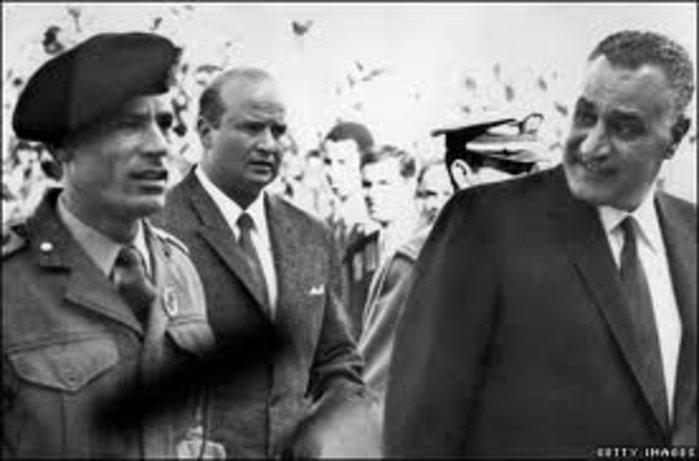
Gaddafi and Nasser in a 1969 Photo. Getty image |
2) National Front for the Salvation of Libya (NFSL)
"With the aim of
overthrowing Libyan strongman Muammar Khadafy, Israel and the U.S.
trained anti-Libyan rebels in a number of West and Central African
countries. The Paris-based African Confidential newsletter reported on
January 5th, 1989, that the US and Israel had set up a series of bases
in Chad and other neighboring countries to train 2000 Libyan rebels
captured by the Chad army. The group, called The National Front for the
Salvation of Libya, was based in Chad."4
"US official records indicate that funding
for the Chad-based secret war against Libya also came from Saudi Arabia,
Egypt, Morocco, Israel and Iraq. The Saudis, for instance, donated $7m
to an opposition group, the National Front for the Salvation of Libya
(also backed by French intelligence and the CIA). But a plan to
assassinate Gadafi and take over the government on 8 May 1984 was
crushed. In the following year, the US asked Egypt to invade Libya and
overthrow Gadafi but President Mubarak refused. By the end of 1985, the
Washington Post had exposed the plan after congressional leaders
opposing it wrote in protest to President Reagan."5
"The FNSL
[National Front for the Salvation of Libya] was part of the National
Conference for the Libyan Opposition held in London in 2005, and British
resources are being used to support the FNSL and other 'opposition' in
Libya.... The FNSL held its national congress in the USA in July 2007.
Reports of 'atrocities' and civilian deaths are being channeled into the
western press from operations in Washington DC, and the opposition FNSL
is reportedly organizing resistance and military attacks from both
inside and outside Libya."6
3) National Conference for the Libyan Opposition (NCLO),
"The main group
leading the insurrection is the National Conference for the Libyan
Opposition which includes the National Front for the Salvation of Libya
(NFSL). The NFSL, which is leading the violence, is a U.S.-sponsored
armed militia of mostly Libyan expatriates and tribes opposed to
al-Qaddafi."7
4) Al-Jama'a al-Islamiyyah al-Muqatilah bi-Libya (Libyan Islamic Fighting Group, LIFG)
"The LIFG was
founded in 1995 by a group of mujahideen veterans who had fought against
the Soviet occupation of Afghanistan. Upon their return to Libya they
grew angry about what they viewed as the corruption and impiety of the
Libyan regime and formed the LIFG to create a state that would show what
they believed to be the true character of the Libyan people.
The most significant LIFG attack was a 1996 attempt to assassinate Gadhafi; LIFG members led by Wadi al-Shateh threw a bomb underneath his motorcade. The group also stages guerilla-style attacks against government security forces from its mountain bases. Although most LIFG members are strictly dedicated to toppling Gadhafi, intelligence reportedly indicates that some have joined forces with al-Qaida to wage jihad against Libyan and Western interests worldwide. ....
As recently as February 2004, then-Director of Central Intelligence George Tenet testified before the Senate Intelligence Committee that "one of the most immediate threats [to U.S. security] is from smaller international Sunni extremist groups that have benefited from al-Qaida links. They include ... the Libyan Islamic Fighting Group."8
"In recent days Libyan officials have distributed security documents giving the details of Sufiyan al-Koumi, said to be a driver for Osama bin Laden, and of another militant allegedly involved in an "Islamic emirate" in Derna, in now-liberated eastern Libya. Koumi, the documents show, was freed in September 2010 as part of a "reform and repent" initiative organised by Saif al-Islam, Gaddafi's son....
The LIFG, established in Afghanistan in the 1990s, has assassinated dozens of Libyan soldiers and policemen. In 2009, to mark Gaddafi's 40 years in power, it apologised for trying to kill him and agreed to lay down its arms. MI6 [British Intelligence] has been accused in the past of supporting it. Six LIFG leaders, still in prison, disavowed their old ways and explained why fighting Gaddafi no longer constituted "legitimate" jihad. Abdul-Hakim al-Hasadi, another freed LIFG member, denied the official claims. "Gaddafi is trying to divide the people," he told al-Jazeera. "He claims that there is an Islamist emirate in Derna and that I am its emir. He is taking advantage of the fact that I am a former political prisoner."
Derna is famous as the home of a large number of suicide bombers in Iraq. It is also deeply hostile to Gaddafi. "Residents of eastern Libya in general, and Derna in particular, view the Gaddadfa (Gaddafi's tribe) as uneducated, uncouth interlopers from an inconsequential part of the country who have 'stolen' the right to rule in Libya," US diplomats were told in 2008, in a cable since released by WikiLeaks.
The last 110 members of the LIFG were freed on 16 February, the day after the Libyan uprising began. One of those released, Abdulwahab Mohammed Kayed, is the brother of Abu Yahya Al Libi, one of al Qaida's top propagandists. Koumi fled Libya and is said to have ended up in Afghanistan working for Bin Laden. Captured in Pakistan, he was handed over to the US and sent to Guantánamo Bay in 2002. In 2009 he was sent back to Libya.9 US counter-terrorist experts have expressed concern that al-Qaida could take advantage of a political vacuum if Gaddafi is overthrown. But most analysts say that, although the Islamists' ideology has strong resonance in eastern Libya, there is no sign that the protests are going to be hijacked by them.10
The most significant LIFG attack was a 1996 attempt to assassinate Gadhafi; LIFG members led by Wadi al-Shateh threw a bomb underneath his motorcade. The group also stages guerilla-style attacks against government security forces from its mountain bases. Although most LIFG members are strictly dedicated to toppling Gadhafi, intelligence reportedly indicates that some have joined forces with al-Qaida to wage jihad against Libyan and Western interests worldwide. ....
As recently as February 2004, then-Director of Central Intelligence George Tenet testified before the Senate Intelligence Committee that "one of the most immediate threats [to U.S. security] is from smaller international Sunni extremist groups that have benefited from al-Qaida links. They include ... the Libyan Islamic Fighting Group."8
"In recent days Libyan officials have distributed security documents giving the details of Sufiyan al-Koumi, said to be a driver for Osama bin Laden, and of another militant allegedly involved in an "Islamic emirate" in Derna, in now-liberated eastern Libya. Koumi, the documents show, was freed in September 2010 as part of a "reform and repent" initiative organised by Saif al-Islam, Gaddafi's son....
The LIFG, established in Afghanistan in the 1990s, has assassinated dozens of Libyan soldiers and policemen. In 2009, to mark Gaddafi's 40 years in power, it apologised for trying to kill him and agreed to lay down its arms. MI6 [British Intelligence] has been accused in the past of supporting it. Six LIFG leaders, still in prison, disavowed their old ways and explained why fighting Gaddafi no longer constituted "legitimate" jihad. Abdul-Hakim al-Hasadi, another freed LIFG member, denied the official claims. "Gaddafi is trying to divide the people," he told al-Jazeera. "He claims that there is an Islamist emirate in Derna and that I am its emir. He is taking advantage of the fact that I am a former political prisoner."
Derna is famous as the home of a large number of suicide bombers in Iraq. It is also deeply hostile to Gaddafi. "Residents of eastern Libya in general, and Derna in particular, view the Gaddadfa (Gaddafi's tribe) as uneducated, uncouth interlopers from an inconsequential part of the country who have 'stolen' the right to rule in Libya," US diplomats were told in 2008, in a cable since released by WikiLeaks.
The last 110 members of the LIFG were freed on 16 February, the day after the Libyan uprising began. One of those released, Abdulwahab Mohammed Kayed, is the brother of Abu Yahya Al Libi, one of al Qaida's top propagandists. Koumi fled Libya and is said to have ended up in Afghanistan working for Bin Laden. Captured in Pakistan, he was handed over to the US and sent to Guantánamo Bay in 2002. In 2009 he was sent back to Libya.9 US counter-terrorist experts have expressed concern that al-Qaida could take advantage of a political vacuum if Gaddafi is overthrown. But most analysts say that, although the Islamists' ideology has strong resonance in eastern Libya, there is no sign that the protests are going to be hijacked by them.10
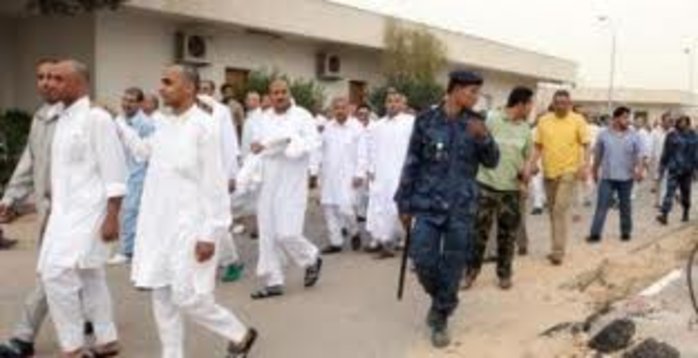
"Fierce clashes between [Qadhafi's] security forces
and Islamist guerrillas erupted in Benghazi in September 1995, leaving
dozens killed on both sides. After weeks of intense fighting, the Libyan
Islamic Fighting Group (LIFG) formally declared its existence in a
communiqué calling Qadhafi's government "an apostate regime that has
blasphemed against the faith of God Almighty" and declaring its
overthrow to be "the foremost duty after faith in God." [3] This and
future LIFG communiqués were issued by Libyan Afghans who had been
granted political asylum in Britain.... The involvement of the British
government in the LIFG campaign against Qadhafi remains the subject of
immense controversy. LIFG's next big operation, a failed attempt to
assassinate Qadhafi in February 1996 that killed several of his
bodyguards, was later said to have been financed by British intelligence
to the tune of $160,000, according to ex-MI5 officer David Shayler. [4]
While Shayler's allegations have not been independently confirmed, it
is clear that Britain allowed LIFG to develop a base of logistical
support and fundraising on its soil. At any rate, financing by bin Laden
appears to have been much more important. According to one report, LIFG
received up to $50,000 from the Saudi terrorist mastermind for each of
its militants killed on the battlefield." [2005]11
"Americans, Britons and the French are finding
themselves as comrades in arms with the rebel Islamic Fighting Group,
the most radical element in the Al Qaeda network [to bring down
Gaddhafi]. Secretary of State Hillary Clinton admitted the risks of the
unholy alliance in a congressional hearing, saying that the Libyan
opposition is probably more anti-American than Muammar Gaddhafi. A
decade ago, this very same delusion of a Western-Islamist partnership in
Kosovo, Bosnia and Chechnya ended abruptly in the 9/11 attacks."12
5) Transitional National Council
"A RIVAL transitional government to the regime of
Libyan leader Muammar Gaddafi looks set to win US and other
international support as momentum builds to oust the longtime dictator.
US Secretary of State Hillary Clinton confirmed yesterday that the Obama administration was reaching out to opponents of Colonel Gaddafi. She said the US was willing to offer ‘any kind of assistance' to remove him from power.
Protest leaders who have taken control in Libya's eastern cities claim to have established a transitional "national council" that amounts to rival rule. They have called on the country's army to join them as they prepare for an attack on the capital, Tripoli, where the Libyan leader retains control.
Confident the Libyan leader's 42-year rule was coming to an end, Mrs Clinton said yesterday: ‘We are just at the beginning of what will follow Gaddafi.'"13
US Secretary of State Hillary Clinton confirmed yesterday that the Obama administration was reaching out to opponents of Colonel Gaddafi. She said the US was willing to offer ‘any kind of assistance' to remove him from power.
Protest leaders who have taken control in Libya's eastern cities claim to have established a transitional "national council" that amounts to rival rule. They have called on the country's army to join them as they prepare for an attack on the capital, Tripoli, where the Libyan leader retains control.
Confident the Libyan leader's 42-year rule was coming to an end, Mrs Clinton said yesterday: ‘We are just at the beginning of what will follow Gaddafi.'"13
6) Facebook
"He [Omar El- Hariri, Chief of Armed Forces for the
Transitional National Council] remained under close surveillance by the
security forces until Feb. 17, when the revolution started. It was not
initiated by prominent figures of the older generation, he said, but
began spontaneously when Tunisia and Egypt inspired the youth. ‘Children
of Facebook!' he declared, in English, with a broad smile."14
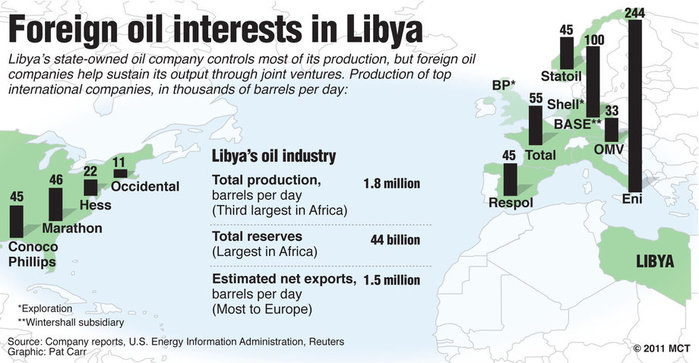
7) Oil
"Libyan rebels in Benghazi said they have created a
new national oil company to replace the corporation controlled by leader
Muammar Qaddafi whose assets were frozen by the United Nations Security
Council.
The Transitional National Council released a statement announcing the decision made at a March 19 meeting to establish the ‘Libyan Oil Company as supervisory authority on oil production and policies in the country, based temporarily in Benghazi, and the appointment of an interim director general" of the company.
The Council also said it "designated the Central Bank of Benghazi as a monetary authority competent in monetary policies in Libya and the appointment of a governor to the Central Bank of Libya, with a temporary headquarters in Benghazi."15
The Transitional National Council released a statement announcing the decision made at a March 19 meeting to establish the ‘Libyan Oil Company as supervisory authority on oil production and policies in the country, based temporarily in Benghazi, and the appointment of an interim director general" of the company.
The Council also said it "designated the Central Bank of Benghazi as a monetary authority competent in monetary policies in Libya and the appointment of a governor to the Central Bank of Libya, with a temporary headquarters in Benghazi."15
|
Peter Dale Scott's Libyan Notebook
II. Where Are the Libyan Rebel Arms Coming From?
Robert Fisk, "Libya in turmoil: America's secret plan to arm Libya's rebels;
Obama asks Saudis to airlift weapons into Benghazi," Independent, March 7, 2011:
Obama asks Saudis to airlift weapons into Benghazi," Independent, March 7, 2011:
"Desperate to avoid US military involvement in Libya
in the event of a prolonged struggle between the Gaddafi regime and its
opponents, the Americans have asked Saudi Arabia if it can supply
weapons to the rebels in Benghazi. The Saudi Kingdom, already facing a
"day of rage" from its 10 per cent Shia Muslim community on Friday, with
a ban on all demonstrations, has so far failed to respond to
Washington's highly classified request, although King Abdullah
personally loathes the Libyan leader, who tried to assassinate him just
over a year ago.
Washington's request is in line with other US
military co-operation with the Saudis. The royal family in Jeddah, which
was deeply involved in the Contra scandal during the Reagan
administration, gave immediate support to American efforts to arm
guerrillas fighting the Soviet army in Afghanistan in 1980 ....
But the Saudis remain the only US Arab ally
strategically placed and capable of furnishing weapons to the guerrillas
of Libya. Their assistance would allow Washington to disclaim any
military involvement in the supply chain - even though the arms would be
American and paid for by the Saudis.
The Saudis have been told that opponents of Gaddafi
need anti-tank rockets and mortars as a first priority to hold off
attacks by Gaddafi's armour, and ground-to-air missiles to shoot down
his fighter-bombers.
Supplies could reach Benghazi within 48 hours but
they would need to be delivered to air bases in Libya or to Benghazi
airport. If the guerrillas can then go on to the offensive and assault
Gaddafi's strongholds in western Libya, the political pressure on
America and Nato - not least from Republican members of Congress - to
establish a no-fly zone would be reduced.
US military planners have already made it clear that a
zone of this kind would necessitate US air attacks on Libya's
functioning, if seriously depleted, anti-aircraft missile bases, thus
bringing Washington directly into the war on the side of Gaddafi's
opponents.
For several days now, US Awacs surveillance aircraft
have been flying around Libya, making constant contact with Malta air
traffic control and requesting details of Libyan flight patterns,
including journeys made in the past 48 hours by Gaddafi's private jet
which flew to Jordan and back to Libya just before the weekend.
Officially, Nato will only describe the presence of
American Awacs planes as part of its post-9/11 Operation Active
Endeavour, which has broad reach to undertake aerial counter-terrorism
measures in the Middle East region.
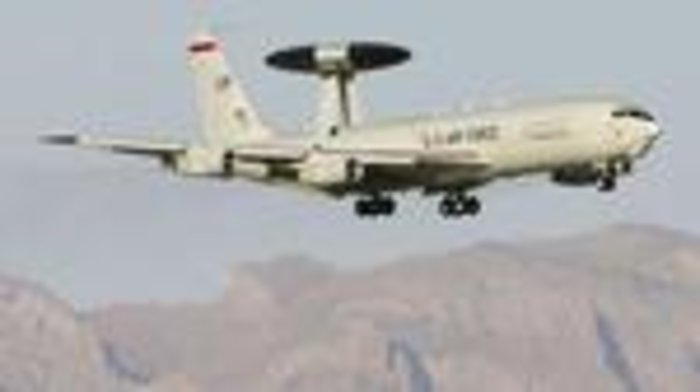
US Awacs monitor Libya |
The data from the Awacs is streamed to all Nato
countries under the mission's existing mandate. Now that Gaddafi has
been reinstated as a super-terrorist in the West's lexicon, however, the
Nato mission can easily be used to search for targets of opportunity in
Libya if active military operations are undertaken.
Al Jazeera English television channel last night
broadcast recordings made by American aircraft to Maltese air traffic
control, requesting information about Libyan flights, especially that of
Gaddafi's jet.
An American Awacs aircraft, tail number LX-N90442
could be heard contacting the Malta control tower on Saturday for
information about a Libyan Dassault-Falcon 900 jet 5A-DCN on its way
from Amman to Mitiga, Gaddafi's own VIP airport.
Nato Awacs 07 is heard to say: "Do you have
information on an aircraft with the Squawk 2017 position about 85 miles
east of our [sic]?"
Malta air traffic control replies: "Seven, that
sounds to be Falcon 900- at flight level 340, with a destination Mitiga,
according to flight plan."
But Saudi Arabia is already facing dangers from a
co-ordinated day of protest by its own Shia Muslim citizens who,
emboldened by the Shia uprising in the neighbouring island of Bahrain,
have called for street protests against the ruling family of al-Saud on
Friday.
After pouring troops and security police into the
province of Qatif last week, the Saudis announced a nationwide ban on
all public demonstrations.
Shia organisers claim that up to 20,000 protesters
plan to demonstrate with women in the front rows to prevent the Saudi
army from opening fire.
If the Saudi government accedes to America's request
to send guns and missiles to Libyan rebels, however, it would be almost
impossible for President Barack Obama to condemn the kingdom for any
violence against the Shias of the north-east provinces.
Thus has the Arab awakening, the demand for democracy
in North Africa, the Shia revolt and the rising against Gaddafi become
entangled in the space of just a few hours with US military priorities
in the region. "16
"Libya rebels coordinating with West on air assault," Los Angeles Times, March 24, 2011
"Reports from the region suggest that the Saudis and
Egyptians have been providing arms. Though U.S. officials could not
confirm that, they say it is plausible."17
"Egypt Said to Arm Libya Rebels," Wall Street Journal, March 17, 2011:
"CAIRO-Egypt's military has begun shipping arms over
the border to Libyan rebels with Washington's knowledge, U.S. and Libyan
rebel officials said.
The shipments-mostly small arms such as assault
rifles and ammunition-appear to be the first confirmed case of an
outside government arming the rebel fighters. Those fighters have been
losing ground for days in the face of a steady westward advance by
forces loyal to Libyan leader Moammar Gadhafi.
The Egyptian shipments are the strongest indication
to date that some Arab countries are heeding Western calls to take a
lead in efforts to intervene on behalf of pro-democracy rebels in their
fight against Mr. Gadhafi in Libya. Washington and other Western
countries have long voiced frustration with Arab states' unwillingness
to help resolve crises in their own region, even as they criticized
Western powers for attempting to do so.
The shipments also follow an unusually robust
diplomatic response from Arab states. There have been rare public calls
for foreign military intervention in an Arab country, including a vote
by the 23-member Arab League last week urging the U.N. to impose a
no-fly zone over Libya.
The vote provided critical political cover to Western
powers wary of intervening militarily without a broad regional and
international mandate. On Thursday evening, the U.N. Security Council
voted on a resolution endorsing a no-fly zone in Libya and authorizing
military action in support of the rebels.
Within the council, Lebanon took a lead role drafting
and circulating the draft of the resolution, which calls for "all
necessary measures" to enforce a ban on flights over Libya. The United
Arab Emirates and Qatar have taken the lead in offering to participate
in enforcing a no-fly zone, according to U.N. diplomats.
Libyan rebel officials in Benghazi, meanwhile, have
praised Qatar from the first days of the uprising, calling the small
Gulf state their staunchest ally. Qatar has consistently pressed behind
the scenes for tough and urgent international action behind the scenes,
these officials said.
Qatari flags fly prominently in rebel-held Benghazi.
After pro-Gadhafi forces retook the town of Ras Lanuf last week, Libyan
state TV broadcast images of food-aid packages bearing the Qatari flag.
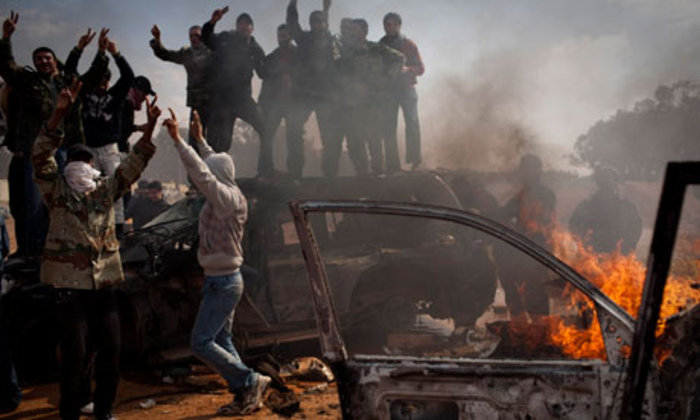
Anti-Gadhafi fighters in Benghazi |
The White House has been reluctant to back calls from
leaders in Congress for arming Libya's rebels directly, arguing that
the U.S. must first fully assess who the fighters are and what policies
they will pursue if they succeeded in toppling Col. Gadhafi. U.S.
officials believe the opposition includes some Islamist elements. They
fear that Islamist groups hostile to the U.S. could try to hijack the
opposition and take any arms that are provided.
The Egyptian weapons transfers began ‘a few days ago'
and are ongoing, according to a senior U.S. official. ‘There's no
formal U.S. policy or acknowledgement that this is going on,' said the
senior official. But ‘this is something we have knowledge of.'
Calls to Egypt's foreign ministry and the spokesman
for the prime minister seeking comment went unanswered. There is no
means of reaching Egypt's military for comment. An Egyptian official in
Washington said he had no knowledge of weapon shipments.
The U.S. official also noted that the shipments
appeared to come "too little, too late" to tip the military balance in
favor of the rebels, who have faced an onslaught from Libyan forces
backed by tanks, artillery and aircraft.
"We know the Egyptian military council is helping us,
but they can't be so visible," said Hani Souflakis, a Libyan
businessman in Cairo who has been acting as a rebel liaison with the
Egyptian government since the uprising began.
"Weapons are getting through," said Mr. Souflakis,
who says he has regular contacts with Egyptian officials in Cairo and
the rebel leadership in Libya. "Americans have given the green light to
the Egyptians to help. The Americans don't want to be involved in a
direct level, but the Egyptians wouldn't do it if they didn't get the
green light."
Western officials and rebel leaders in Libya said the
U.S. has wanted to avoid being seen as taking a leadership role in any
military action against Mr. Gadhafi after its invasions of Iraq and
Afganistan fueled anger and mistrust with Washington throughout the
region.
But the U.S. stated clearly it wants Mr. Gadhafi out
of power and has signaled it would support those offering help to the
rebels militarily or otherwise.
A spokesman for the rebel government in Benghazi said
arms shipments have begun arriving to the rebels but declined to
specify where they came from.
"Our military committee is purchasing arms and arming
our people. The weapons are coming, but the nature of the weapons, the
amount, where it's coming from, that has been classified," said the
spokesman, Mustafa al-Gherryani.
The U.S. official said Egypt wanted to keep the
shipments covert. In public, Egypt has sought to maintain a neutral
stance toward the rebel uprising in Libya. Egypt abstained during the
Arab League's vote calling for the U.N. to impose a no-fly zone on Mr.
Gadhafi, according to people familiar with the internal Arab League
deliberations.
Hundreds of thousands of Egyptian laborers are believed to still be in Libya.
On the other hand, the Egyptian military's covert
support for the rebels suggests that it has calculated that Mr. Gadhafi
is unlikely to remain in power, at least in the eastern half of the
country, and therefore Egypt is eager to begin to build good relations
with the rebels.
Rebel forces in the past 24 hours appeared to make
some progress fending off pro-Gadhafi forces' assaults and have rolled
out new weapons for the first time since the uprising began last month.
Among them are rebel tanks that have taken up positions on the front
lines in recent days. Rebels also launched fighter-jet attacks on
government positions on Wednesday for the first time so far.
The tanks and fighter jets are believed to have been
among the weapons seized by rebels from defected units of the Libyan
army in the eastern half of the country, but they have received spare
parts or trained mechanics from outside the country to help them deploy
them, some rebel officials have speculated.
-Sam Dagher and Adam Entous contributed to this article.18
-Sam Dagher and Adam Entous contributed to this article.18
Benjamin Gottlieb, "Egypt Arms Libyan Rebels As Gaddafi's Conquest Continues," NeonTommy Annenberg Digital News, March 17, 2011:
Arms shipments from Egypt's military have begun
flowing across the border into Libya with U.S. knowledge, Libyan rebels
and U.S. officials said Thursday.
Made up mostly of small arms, such as assault rifles
and ammunition, the shipments are the first confirmed reports of an
outside government supporting rebel fighters with weapons. Rebels have
been loosing ground for days against pro-Gaddafi forces aiming to end
the conflict before foreign intervention plans are finalized.
Although the U.N. approved a "no-fly zone" over Libya
late Thursday, rebel forces fear that any planned foreign intervention
would be too little to late.

No-Fly Zone |
The shipment of arms indicated an unusually bold
response by an Arab nation intervening in a conflict outside its
borders. There have also been rare public decrees for the West to
intervene in the conflict - the Arab League voted 23-0 last week
encouraging the U.N. to impose the "no-fly zone" over Libya.
In spite of reports of arms flowing across the
Egyptian boarder, Egyptian Foreign Ministry spokeswoman Menha Bakhoum
told Reuters that Egypt would not be involved in any military
intervention in neighboring Libya.
"Egypt will not be among those Arab states. We will
not be involved in any military intervention. No intervention period,"
Bakhoum said.
Bakhoum was responding to comments by U.S. Secretary
of State Hillary Clinton, who said Thursday that discussions were on the
table regarding Arab involvement in U.S. and European intervention in
the conflict.
Clinton has said repeatedly that the U.S. desires involvement from a neighboring Arab nation in any planned intervention.
A Libyan rebel government spokesman in Benghazi,
Mustafa al-Gherryani, said rebels have begun receiving arms shipments
from neighboring nations, however he declined to reveal their origin.
"Our military committee is purchasing arms and arming
our people. The weapons are coming, but the nature of the weapons, the
amount, where it's coming from, that has been classified," he said.19
Yoichi Shimatsu, "Mideast Revolutions and 9-11 Intrigues Created in Qatar," New America Media, March 1, 2011
"It may puzzle and perhaps dismay young protesters in
Benghazi, Cairo and Tunisia that their democratic hopes are being
manipulated by an ultra-conservative Arab elite which has underhandedly
backed a surge of militant Islamist radicals across North Africa.
Credible U.S. intelligence reports have cited evidence pointing to
Qatar's long-running support for the Muslim Brotherhood, Al Qaeda and
jihadist fighters returning from Afghanistan.
The links to Qatar uncovered by anti-terrorism
investigators in the wake of 9-11 need to be reexamined now that the
Libyan Islamic Fighting Group (LIFG), an on-and-off affiliate of Al
Qaeda, has seized armories across half of the North African country.
Libya's well-stocked arsenals contain high-power explosives, rocket
launchers and chemical weapons. LIFG is on the State Department's
terrorist list.
Most worrying, according to a U.S. intelligence
official cited by CNN, is the probable loss of chemical weapons. The
Federation of American Scientists reports that, as of 2008, only 40
percent of Libya's mustard gas was destroyed in the second round of
decommissioning. Chemical canisters along the Egyptian border were yet
to be retrieved and are now presumably in the hands of armed militants.
After initially letting slip that the earliest Libyan
protests were organized by the LIFG, Al Jazeera quickly changed its
line to present a heavily filtered account portraying the events as
‘peaceful protests'. To explain away the gunshot deaths of Libyan
soldiers during the uprising, the Qatar-based network presented a
bizarre scenario of 150 dead soldiers in Libya having been executed by
their officers for ‘refusing to fight'. The mysterious officers then
miraculously vacated their base disappearing into thin air while
surrounded by angry protesters! Off the record, one American
intelligence analyst called these media claims an ‘absurdity' and
suggested instead the obvious: that the soldiers were gunned down in an
armed assault by war-hardened returned militants from Iraq and
Afghanistan....
According to a Congressional Research Service report of January 2008, ‘Some observers have raised questions about possible support for Al Qaeda by some Qatari citizens, including members of Qatar's large ruling family. According to the 9/11 Commission Report, Qatar's Interior Minister provided a safe haven to 9/11 mastermind Khalid Shaikh Mohammed during the mid-1990s, and press reports indicate other terrorists may have received financial support or safe haven in Qatar after September 11, 2001.'
According to a Congressional Research Service report of January 2008, ‘Some observers have raised questions about possible support for Al Qaeda by some Qatari citizens, including members of Qatar's large ruling family. According to the 9/11 Commission Report, Qatar's Interior Minister provided a safe haven to 9/11 mastermind Khalid Shaikh Mohammed during the mid-1990s, and press reports indicate other terrorists may have received financial support or safe haven in Qatar after September 11, 2001.'
The national security chief, Interior Minister
Abdullah bin Khalid al-Thani, is further mentioned as paying for a 1995
trip by Khalid Shaikh Mohammed ‘to join the Bosnia jihad.' The report
recalls how after the 1993 World Trade Center bombing, FBI officials
"narrowly missed an opportunity to capture" the suspect in Qatar.
‘Former U.S. officials have since stated their belief that a
high-ranking member of the Qatari government alerted him to the
impending raid, allowing him to flee the country.'"20
Peter Dale Scott, a former Canadian diplomat and English Professor at the University of California, Berkeley, is the author of Drugs Oil and War, The Road to 9/11, The War Conspiracy: JFK, 9/11, and the Deep Politics of War. His most recent book is American War Machine: Deep Politics, the CIA Global Drug Connection and the Road to Afghanistan. Peter Dale Scott is a Research Associate of the Centre for Research on Globalization (CRG).
His most recent book is American War Machine: Deep Politics, the CIA Global Drug Connection and the Road to Afghanistan.
His website, which contains a wealth of his writings, is here.
1 “Defense Secretary Gates, who recently warned against any further protracted US ground war, said on March 23 that the end of military action in Libya is unknown and could last longer than a few weeks. ‘I think there are any number of possible outcomes here and no one is in a position to predict them,’ Gates told reporters in Egypt” (C-Span, March 24, 2011).
2 Interested readers may wish to consult my first exploration, “Googling ‘Revolution’ in North Africa.”
3 Dan Lieberman, “Muammar Al Gaddafi Meets His Own Rebels,” CounterCurrents.org, March 9, 2011.
4 Joel Bainerman, Inside the Covert Operations of the CIA & Israel's Mossad (New York: S.P.I. Books, 1994), 14.
5 Richard Keeble, “The Secret War Against Libya,” MediaLens, 2002.
6 "Petroleum and Empire in North Africa. NATO Invasion of Libya Underway," By Keith Harmon Snow, 2 March 2011.
7 Ghali Hassan, “U.S. Love Affair with Murderous Dictators and Hate for Democracy.” Axis of Logic, Mar 17, 2011.
8 Center for Defense Information, “In the Spotlight: The Libyan Islamic Fighting Group (LIFG),” January 18, 2005
9 Qadhafi was concerned about Al Qaeda terrorism in Libya, and in 1996 Libya became the first government to place Osama bin Laden on Interpol’s Wanted List (Rohan Gunaratna, Inside Al Qaeda: Global Network of Terror [New York: Columbia UP, 2002], 142). Thereafter American and Libyan intelligence collaborated closely for some years against Al Qaeda. Beginning when?
10 Ian Black, “Libya rebels rejects Gaddafi's al-Qaida spin,” Guardian, March 1, 2011.
11 Gary Gambill, "The Islamic Fighting Group (LIFG), Jamestown Foundation," Terrorism Monitor, May 5, 2005,; citing Al-Hayat (London), 20 October 1995 [“communiqué”]; "The Shayler affair: The spooks, the Colonel and the jailed whistle-blower," The Observer (London), 9 August 1998; Jean-Charles Brisard and Guillaume Dasquié, Ben Laden: La Verite interdite (Bin Ladin: The Forbidden Truth). Cf. also Annie Machon, Spies, Lies and Whistleblowers: MI5, MI6 And the Shayler Affair (Book Guild Publishing, 2005) [Shayler].
12 Yoichi Shimatsu, “Attack on Libya: Why Odyssey Dawn Is Doomed,” New America Media, March 20, 2011.
13 “US reaches out to Libyan insurgents,” The Australian, March 1, 2011,
14 “How a onetime friend to Gadhafi became his rival,” Globe and Mail [Toronto], March 4, 2011.
15 Libyan Rebel Council in Benghazi Forms Oil Company to Replace Qaddafi’s,” Bloomberg, March 22, 2011.
16 Robert Fisk, “America's secret plan to arm Libya's rebels,” Independent, March 7, 2011.
17 “Libya rebels coordinating with West on air assault,” Los Angeles Times, March 24, 2011.
18 “Egypt Said to Arm Libya Rebels,” Wall Street Journal, March 17, 2011,
19 Benjamin Gottlieb, “Egypt Arms Libyan Rebels As Gaddafi's Conquest Continues,” NeonTommy Annenberg Digital News, March 17, 2011.
20 Yoichi Shimatsu, “Mideast Revolutions and 9-11 Intrigues Created in Qatar,” New America Media, March 1, 2011. The al-Thani family’s protection of Khalid Shaikh Mohammed is confirmed by former CIA officer Robert Baer (Los Angeles Times, March 23, 2003). Cf. Robert Baer, Sleeping with the Devil (New York: Crown, 2003); Peter Lance, Triple Cross (New York: Regan/HarperCollins, 2006), 234-37.

