
THE F-35 STEALTH FIGHTER PROGRAM:
How the War Economy Contributes to Exacerbating the Social Crisis
By Prof. Michel Chossudovsky
Global Research, April 4, 2012
URL of this article: www.globalresearch.ca/index.php?context=va&aid=30144
There
is mounting controversy regarding the purchase of the F-35 stealth
fighter jet from US defence giant Lockheed Martin. The Pentagon has
commissioned the purchase of 2,443 aircraft "to provide the bulk of its
tactical airpower for the US Air Force, Marine Corps and Navy over the
coming decades". This massive procurement of advanced weapons systems is
part of America's "Global War", largely directed against China, Russia,
North Korea and Iran.
The overall cost of the program to the US military is
estimated at a staggering $1.51 trillion over the so called life cycle
of the program, namely $618 million per plane. (Shalal-Esa, Andrea. "Government sees lifetime cost of F-35 fighter at $1.51 trillion." Reuters, 2 April 2012).
Several of America's close allies including the UK,
Australia, Italy, Canada, the Netherlands, Norway, Turkey, Israel, and
Japan are slated to purchase the F-35 stealth fighter plane.
The economic and social implications of this program
are potentially devastating. Apart from the fact that the fighter planes
will be used in upcoming US-NATO wars, resulting in inevitable civilian
deaths, their procurement --at tax payers expense-- will contribute to
exacerbating the ongoing fiscal crisis. Unless they are solely funded by
an increase in the public debt (which is highly unlikely), these
massive expenditures on advanced weapons systems will require the
adoption of concurrent austerity measures over a period of up to thirty
years, at the expense of an entire generation.
The costs of military procurement are always at the
expense of social programs, public investment in infrastructure,
employment creation in the civilian economy. Conversely, very few jobs
will be created by the defence contractors. The cost of creating one job
in America's weapons industry (2001) varies between 25 and 66 million
dollars per job. (Michel Chossudovsky, War is Good for Business, Global Research, September 2001)
In the US and NATO member countries, drastic
budgetary measures are currently being applied with a view to financing
the "war economy". These economic measures --adopted at the crossroads
of a Worldwide economic depression-- are also contributing to
spearheading entire national economies into bankruptcy, with devastating
social consequences.
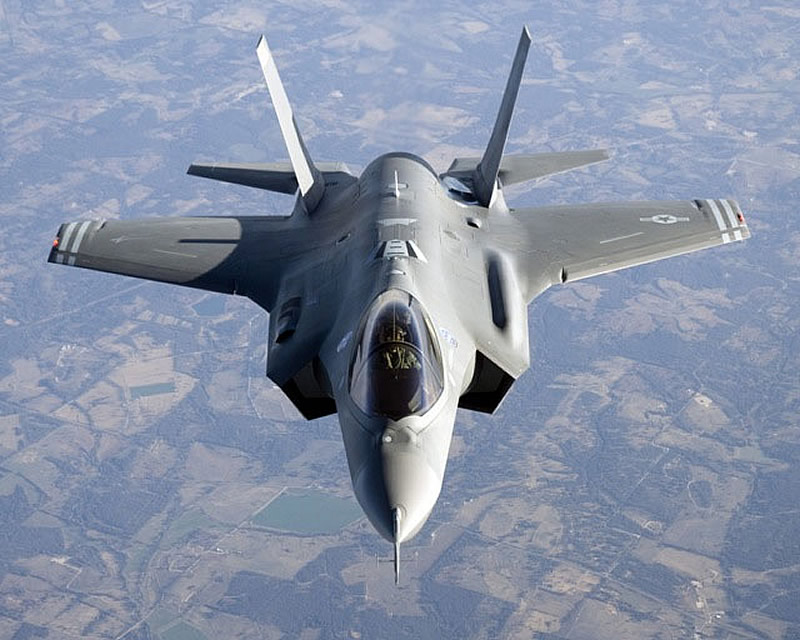
Canada's F-35 Program
In Canada, the Conservative government had initially
committed itself to an overall cost of the F-35 stealth fighter program
of 9 billion dollars involving the purchase of 65 aircraft. This figure
of 9 billion dollars was a political cover-up. Known and documented, the
real cost of the program was much larger. Auditor-General Michael
Ferguson's report presented to the House of Commons (April 2), confirmed
that the cost of Canada's F-35 programme "could reach $30 billion over
three decades", namely $461 million per plane:
"In March 2011, the Parliamentary Budget Officer (PBO) provided Parliament with a report on the estimated acquisition and sustainment [sic] costs associated with Canada's planned purchase of 65 F-35 fighter jets. Shortly thereafter, the Department of National Defence (DND) responded to the PBO report. In that response, DND claimed that the total costs associated with the F-35 program would be approximately $15 billion. However, the recent auditor general's report reveals that, in June 2010, DND's true cost estimate was approximately $25 billion -- representing a difference of $10 billion. The inclusion of this difference would bring DND's cost estimate in line with that of the PBO,"
It is worth noting that the estimated unit cost in
Canada's program ($461 million per aircraft) which has been the object
of political controversy is substantially lower than that of the US
(estimated at $661 million) and Norway (estimated to be of the order of
$769 million over the "operational lifetime" of the F-35 aircraft).
(Testimony of Rear Admiral Arne Røksund, "41st Parliament, 1st Session, Standing Committee on National Defence." Parliament of Canada, 24 November 2011).
Ottawa's 2012 Austerity Budget
Careful timing: The 30 billion dollar cost of the
F-35 programme was known prior to the presentation of the budget. The
report of Canada's Auditor General (April 3), however, regarding the
cost overrun was only made public ex post facto, five days after the budget speech by Finance Minister Flaherty on March 29.
The 2012 Canadian federal budget presented a gruesome
scenario of austerity measures requiring massive layoffs of federal
government employees, drastic cuts in spending including pension funds
and the curtailment of federal provincial transfers. In contrast, the
issue of spiralling defense spending resulting from the F-35 fighter
program is not acknowledged, as if it has no bearing on the structure of
public expenditure.
The government had announced drastic austerity
measures, but these budgetary measures apply largely to non-military
spending. (The federal budget estimates indicate a modest cut in defence
expenditure, which do not include predictable overruns in the cost of
weapons procurement).
The crucial question: How does this multibillion
dollar F-35 project affect the 2012 federal budget, which is largely
predicated on a sizeable curtailment of "civilian" as opposed to
"military" expenditures?
The issue of the budget deficit could be resolved
overnight by reining in the war economy. But that "solution" would not
be in the interest of achieving "World peace" and "global security".
"Guns versus Butter": How does this spiralling
defence expenditure allocated to the purchase of advanced weapons
systems affect all other categories of civilian government expenditure? How does it affect public investment in the civilian economy?
These questions are of crucial significance for the
people of the United States, whose government is spending a staggering
$1.5 trillion on the F-35 program. It has similar implications for the
nine countries which decided to purchase these expensive fighter planes,
while concurrently implementing "strong economic medicine" to finance
the predictable cost overruns of military spending.
"War is good for business" (for the defence contractors) yet at the same it spearheads the civilian economy into bankruptcy.
Nowhere in the Canadian federal budget is the issue
of the F-35 program and its staggering overall cost of 30 billion
dollars mentioned. That's an average cost of $461 million dollars per
plane, including the "flyaway" purchase plus the so-called sustainment
costs (maintenance, operating costs and related investments associated
with the F-35 program).
Canada's Welfare State is collapsing, health care is
in the process of being privatised, primary and secondary education is
under-funded. Universities are in a state of crisis with rising tuition
fees. Yet at no point in the debate on the 2012 federal budget has the
issue of the war economy been raised.
How does the war economy backlash on people's lives? How does it undermine and destabilize the civilian economy? How does it affect the funding of social programs?
How does the war economy backlash on people's lives? How does it undermine and destabilize the civilian economy? How does it affect the funding of social programs?
What should be understood is that the austerity measures are in part implemented with a view to financing the war economy.
The Protest Movement
The protest movement against the economic austerity measures must integrated be with the antiwar movement.
The abolition of war is a precondition for scrapping the neoliberal economic agenda. War and Globalization are intimately related.
The Protest Movement
The protest movement against the economic austerity measures must integrated be with the antiwar movement.
The abolition of war is a precondition for scrapping the neoliberal economic agenda. War and Globalization are intimately related.
University students in Quebec have recently been
involved in mass demonstrations regarding the hike of tuition fees
implemented by the provincial government. Yet at no time has the issue
of of military spending and its impact on social programs been raised.
The purchase of advanced weapons systems will inevitably be at the expense of federal provincial transfers which contribute to the financing of health and education.
The purchase of advanced weapons systems will inevitably be at the expense of federal provincial transfers which contribute to the financing of health and education.
Curtailing the F-35 stealth fighter program would
immediately make more money available in support of Quebec's university
students. In fact the cost associated with one F-35 fighter plane (461
million dollars) would release more than enough resources to finance the
hike in tuition fees for years to come.
The protest movement against government austerity
measures applied in the US, Canada and the European Union must address
the issue of the US-NATO led war.
The F-35 stealth aircraft are not weapons of peace.
They are part of the killing machine. They are slated to be used against
China, Russia, Iran and North Korea.
They are "weapons of mass destruction" to be used in the Pentagon's "long war".
The other side of the coin pertains to "Guns versus Butter", namely the relationship between the "civilian economy" and the "war economy".
War and the neoliberal economic policy agenda are part of an integrated process.
The staggering cost of these advanced weapons is contributing to the demise of what is left of the Welfare State, not to mention the impoverishment --in several NATO member countries-- of an entire generation.
They are "weapons of mass destruction" to be used in the Pentagon's "long war".
The other side of the coin pertains to "Guns versus Butter", namely the relationship between the "civilian economy" and the "war economy".
War and the neoliberal economic policy agenda are part of an integrated process.
The staggering cost of these advanced weapons is contributing to the demise of what is left of the Welfare State, not to mention the impoverishment --in several NATO member countries-- of an entire generation.

